Key Takeaways
- A mixer is not really a “mixing” purchase, it’s a scrap-and-material cost decision. Its real value shows up in your rejection rate and how much regrind you can safely use, not in the mixing itself.
- Mixing quality is decided by three things only: blade design, speed, and time. Everything else on a spec sheet is secondary.
- The mixer’s job is consistency, not speed. Its purpose is to make the last part of a batch identical to the first.
- Match the mixer to your material, not just your capacity. Granules mix easily; powders, fillers. But sticky additives need a different design, this is the most common mismatch.
- Stainless steel isn’t a luxury for some products. For food-grade and clear plastics, drum material is a contamination issue, not a finish upgrade.
A plastic mixer machine is an important piece of equipment used in plastic processing to blend plastic materials, additives, colors, and other ingredients evenly. Proper mixing helps manufacturers achieve consistent quality, better material performance, and smoother production. From plastic granules and regrind to masterbatch and additives, the right mixer can improve the overall efficiency of a manufacturing line.
For plastic manufacturers, choosing the right plastic mixer machine depends on the type of material, required mixing capacity, production process, and desired output.
With this guide, we explain what these machines do, the types available, where each fits and what you gain from adding one to your line.
What is a Plastic Mixer Machine?
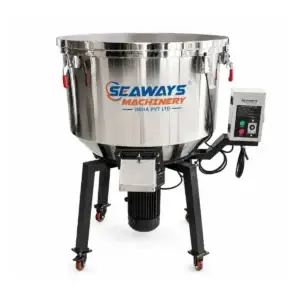
A plastic mixer machine is a part of auxiliary equipment that blends two or more plastic materials into a single uniform mixture before processing. A typical batch holds virgin granules, ground regrind, colour masterbatch and sometimes fillers or additives. The machine turns them together for a set time so that every handful taken from the batch has the same composition.
It is used between your grinding & drying stages and your main processing machine. Material is ground, mixed, dried, then fed to the injection moulding, blow moulding or extrusion machine.
How Does a Plastic Mixer Machine Work?
Material is loaded into a drum or barre.A motor turns a blade or screw inside the machine, which moves the material from the bottom to the top and mixes it evenly. After a set amount of time, the mixture becomes uniform and is released through an outlet at the bottom.
The three things that decide mixing quality are blade design, rotation speed and mixing time. A vertical machine running at around 85 rpm with a timer set between 0 and 30 minutes covers most everyday plastic blends. Heavier fillers and very fine powders need longer cycles or a faster blade.
What Are the Types of Plastic Mixer Machines?
There are four types of plastic mixers commonly used in the Indian plastics industry. They mainly differ in how they move and mix the material, but all have the same purpose to mix plastic materials evenly.
1. Vertical Batch Mixer
Vertical batch mixer is the most commonly used plastic mixing machine in small and medium-sized factories. It has a vertical barrel where the material is placed. A central blade lifts the material from the bottom and mixes it evenly. Batch sizes usually run from 50 kg to 200 kg. The machine is usually fitted with wheels, so it can be easily moved from one processing machine to another. It mixes quickly, uses less power, and is easy to clean, making it a good choice for moulding units that frequently change colours.
2. Horizontal Ribbon Mixer
A horizontal ribbon mixer has a long, horizontal container with a spiral-shaped blade inside. The blade pushes material outward while the inner edge pulls it back, giving gentle movement across a wide area. These mixers are suitable for large quantities of material, powders, and fillers, so they are commonly used for plastic compounding and PVC processing. However, they need more floor space and usually cost more to install than vertical mixers.
3. High Speed Mixer
The fast-moving blade creates heat through friction, which helps PVC powders absorb liquid additives such as stabilisers and plasticisers. A high speed mixer machine does more than just mix the materials. It helps with the processing of the ingredients. This one is a chemical process as much as a mixing process, and it is normally paired with a cooling mixer that brings the hot blend back down before storage.
4. Drum or Tumbler Mixer
A drum or tumbler mixer rotates the entire drum at an angle, allowing the material to tumble and mix inside. It does not use a blade, so the plastic granules are mixed gently without damage or extra heat. It is best for free-flowing plastic granules. However, it is not very effective for powders or materials with very different particle sizes.
Plastic Mixer Machines: Quick Comparison
| Type | Usual capacity | Blade speed | Best suited to |
| Vertical batch mixer | 50 to 200 kg | Around 85 rpm | Granules, regrind and masterbatch |
| Horizontal ribbon mixer | 100 to 1,000 kg | Low | Powders, fillers, compounding |
| High speed mixer | 50 to 500 kg | Very high | PVC dry blend with additives |
| Drum or tumbler mixer | 25 to 200 kg | Low | Gentle granule blending |
Where is a Plastic Mixer Machine Used?
Any plant that processes more than one material together needs mixing. The machine is the same, only the method changes.
- Injection moulding units blend virgin granules with regrind and masterbatch so colour and part weight stay steady across a long run.
- Extrusion lines need a stable feed blend, because a change in composition mid-run shows up as a thickness variation in the pipe, sheet or film.
- Plastic recycling plants mix reground scrap with virgin material in a fixed ratio to keep the finished product strong enough.
- Masterbatch and compounding units combine base resin with pigments, fillers and additives before pelletising.
- Blow moulding units rely on even colour distribution so that containers from one batch look identical on the shelf.
The materials handled include PP, HDPE, LDPE, PVC, PET, ABS, nylon, HIPS, polycarbonate, BOPP, PMMA and EVA.
What are the Advantages of a Plastic Mixer Machine?
The return on a mixer shows up in three places: rejection rate, material cost and operator time.
Even colour across the batch. The masterbatch mixes evenly throughout the batch, so the colour stays consistent from the first product to the last.
Higher regrind usage. A good mixer helps you use more recycled plastic safely and consistently. This can reduce the amount of virgin plastic you need to buy.
Fewer rejections. Even mixing gives more consistent material, which helps maintain stable part weight, reduce short shots, and less scrap going back to the grinder.
Faster changeovers. A removable blade and wide outlet make it easier to empty and clean the mixer quickly when changing materials or colours.
Lower labour cost. Hand mixing takes more time and can produce uneven results. A mixer uses a fixed mixing cycle, frees the operator for other work & removes human judgement and gives more consistent results.
Cleaner material. A stainless steel drum keeps the blend free of rust and contamination, which is especially important for food-grade and clear plastic products.
How Do You Choose the Right Plastic Mixer Machine?
The right mixer should match your production needs and the space available in your factory. Four points settle most decisions.
Batch capacity. Calculate how many kilos of material your machine uses every hour. Choose a mixer that can prepare enough material for about one to two hours of production. A mixer that is too small will need frequent refilling, while a very large mixer may leave material unused for too long.
Motor power. Denser materials and heavier fillers need more torque, so more motor power. A 50 kg model runs comfortably on 1.5 kW, while a 200 kg batch needs around 7.5 kW.
Material type. Plastic granules are generally easy to mix. Fine powders, fibres and sticky additives need a design suited to them, so tell the supplier exactly which materials you use.
Floor space and mobility. A vertical mixer with wheels is a good option when one mixer needs to serve several machines. It can be easily moved around the factory as needed.
What Does a Plastic Mixer Machine Cost in India?
The price of a plastic mixer depends on factors such as batch capacity, motor power, drum material, and extra features like automatic loading or heating.
A 50 kg vertical batch mixer may start at around ₹65,000, while larger models usually cost more. Buying directly from the manufacturer can help you save on dealer costs and makes it easier to get spare parts, service, and technical support.
Getting the Mixing Stage Right
Mixing is the least glamorous stage of a plastic production line and one of the most decisive. Grinding, drying and moulding all work better when the material reaching them is consistent.
Seaways Machinery has manufactured plastic auxiliary equipment from Rajkot since 1995, including vertical batch mixers in four models from 50 kg to 200 kg, with pan-India delivery, installation and after-sales support.
Share your material type and hourly production requirement to find the mixer capacity that best suits your production line.
You May Also Like: