Key Takeaways:
- The cheap option slowly becomes the expensive one. Individual hopper loaders look cheaper, but every new machine adds another motor, filter, and failure point. Labour, spillage, rejects and downtime add up. Most factories reach the point where the old method costs more than it saves.
- Design for your busiest day, not your average day. A system sized for “normal” demand will fail during start-ups and colour changes. Those are exactly the moments you can’t afford a stoppage. A 20-30% safety margin is a must.
- Plan for the factory you’ll have in 3-5 years. Leaving extra room in pipes and the selector station today costs little. Rebuilding later costs a lot. Consider phased installation over weekends, so you don’t have to stop production to upgrade.
- A clean plant helps you win customers. When big brands audit your factory, an automated, dust-free setup signals that you’re a serious supplier. When you buy a system, avoid anyone who quotes a price without visiting your plant.
Walk into almost any growing plastic factory, and you will see the same scene. 20 machines are running. Each one has its own hopper loader humming on top. Half-opened bags of granular material are lying on the ground. One operator climbs a ladder to top up a dryer. Another person cleans up the material scattered near the machines.
Nobody planned it this way. The factory simply grew one that way, gradually.
If this sounds like your plant, then you have to fix this. We have seen this pattern in dozens of factories. The good news is that there is a better way to move raw material, and it is called a central material conveying system.
In this guide, you will learn what it is, how it works, what it costs you not to have one, and how to choose the right setup for your factory.
What Is a Central Material Conveying System?
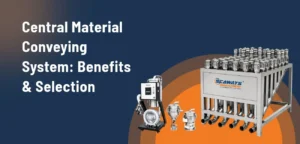
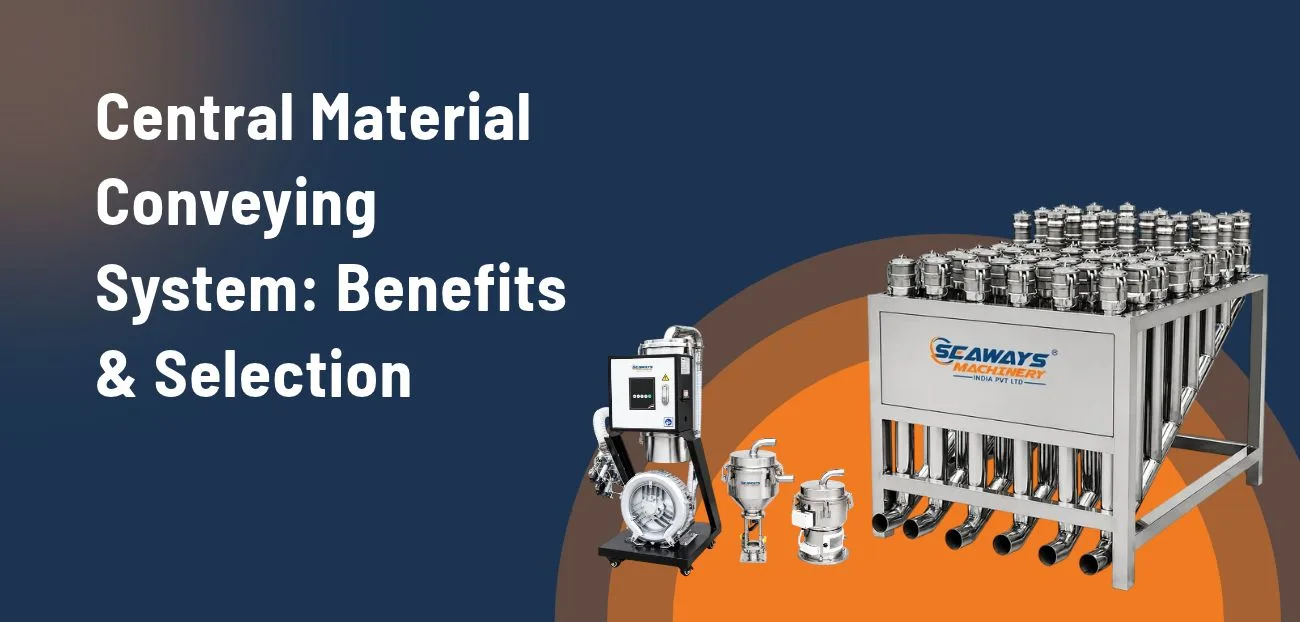
A central material conveying system is a network that automatically moves plastic granules from one central storage area to every processing machine in your plant. It uses vacuum pumps, pipelines, and smart controls to do this.
Each machine no longer needs its own loader, motor and filter. Instead, a few powerful central vacuum units serve all the machines through a shared pipe network. Material travels from silos, octabins or dryers straight into small vacuum receivers mounted on each injection moulding machine, extruder or blow moulding machine.
Think of it like the water supply in a building. You don’t carry buckets to every tap. The water simply arrives when you need it. Central material handling works the same way for your resin.
Individual Hopper Loaders vs Central Material Distribution System
Individual hopper loaders are a great starting point. They are cheap, simple and quick to install. For a plant with three to five machines, they often make perfect sense.
The trouble starts as you grow. Every new machine brings another loader, another motor to service and another filter to clean. It also brings one more place where things can go wrong.
Here is an honest comparison:
| Factor | Individual Hopper Loaders | Central Material Distribution System |
| Initial cost | Low per machine | Higher upfront investment |
| Best for | 1-6 machines | 8+ machines or planned expansion |
| Noise and heat on floor | High | Low |
| Dust and spillage | Common | Minimal, with closed pipelines |
| Labour needed | Manual filling at each machine | Mostly automatic |
| Material control | Scattered | Centralized and traceable |
| Energy use | Many small motors | Fewer, more efficient pumps |
| Expansion | Add another loader | Add a receiver and a pipe branch |
The real question is not “Which is better?” It is “At what point does my current method start costing me more than it saves?” For most plants, that point arrives sooner than they expect.
How Does a Central Feeding System Work?
An automatic plastic granule feeding system may look complex, but the logic is simple. Here is the journey a single granule takes:
- Storage: Raw material is stored in outdoor silos, indoor bins, octabins or bags at a central material station.
- Drying (if needed): Hygroscopic materials like PET, PA, PC and ABS first go through a central dehumidifying dryer to remove moisture.
- Selection: At the material selector station, also called a coupling station, each machine gets connected to the right material source. This prevents mix-ups.
- Conveying: A central vacuum pump creates suction. The granules travel through stainless steel or aluminium pipelines to the machine that needs them.
- Receiving: A vacuum receiver on each machine collects the material and drops it into the hopper, often through a gravimetric blender that adds masterbatch or regrind.
- Filtering: A central dust filter or cyclone captures fines before the air returns to the vacuum pump. This protects the pump and keeps the plant clean.
- Control: A PLC control system with a touch screen manages the whole sequence. It decides which machine gets material and when, and it alerts operators if anything goes wrong.
One detail that experienced engineers never skip is the material cut-off valve (purge valve). It clears leftover granules from the line after each cycle. Without it, material stays in the pipe, which causes blockages and contamination when you change materials.
Advantages for Factories with Multiple Machines
Here are the benefits plant managers tell us they value most after they switch to central material handling:
- Lower labour costs: Operators stop carrying bags and climbing ladders. They focus on quality and production instead.
- Cleaner, safer floors: Closed pipelines mean far less dust and spilled granules, and fewer slip hazards.
- Less cross-contamination: The selector station and purge valves keep each material on its own path.
- Quieter, cooler workshop: Removing a motor from every machine noticeably lowers noise and heat around the production area.
- Better energy efficiency: A few well-sized central pumps often use less power than dozens of small loader motors.
- Consistent quality: Dried material reaches the machine on time, so you see fewer silver streaks, bubbles and rejects.
- Easy to grow: Adding a machine means adding a receiver and a pipe branch, not rebuilding the system.
- Professional image: Customers who audit your plant notice a clean, automated material system. It builds their trust in you.
That last point gets overlooked. When a big brand owner visits your factory, a tidy, automated production line says “this supplier is serious” before you say a word.
System Layout, Conveying Distance and Capacity Considerations
This is where good systems and poor systems part ways. A system that is sized correctly runs flawlessly for years. A poorly sized one becomes a daily headache.
1. Plan the Layout Around Material Flow
Start by mapping your floor. Mark where trucks unload, where material is stored and dried, and where each machine is stored. Make the layout to keep the central station close to the machines.
Always plan for growth. If you expect to add ten machines in three years, leave room in the pipe network and the selector station today. Adding capacity later costs far more than planning for it now.
2. Conveying Distance and Pipe Size
Vacuum conveying works well over long distances, but every metre, bend and vertical lift reduces performance. Many plant systems run comfortably at 100 to 200 metres, and longer runs are possible with the right design.
Keep these rules in mind:
- Use long-radius bends to reduce wear and the formation of “angel hair” (streamers).
- Choose the pipe diameter to match throughput. Common sizes are 38, 51, 63 and 76 mm.
- Use wear-resistant pipe bends for glass-filled or abrasive materials.
3. Calculating Capacity
Add up the hourly material use of all machines that run at the same time, then add a safety margin of around 20-30%. Also consider:
- Bulk density of each material.
- Number of materials and colours used at once.
- Peak demand during start-ups and colour changes.
A system sized only for “average” demand will struggle on your busiest day, and that is exactly the day you can’t afford a stoppage.
Installation and Maintenance Considerations
Installation
A smooth installation depends on good planning. Before work begins, make sure that:
- Pipe routes avoid cranes, walkways and future machine spots.
- The pipelines are properly grounded to prevent static build-up.
- Compressed air and electrical supply are ready where needed.
- Installation is planned in phases, so production does not stop.
Experienced suppliers often connect machines in groups over weekends or planned shutdowns. Ask about this early. It can save you days of lost output.
Maintenance
A central system needs far less daily attention than dozens of loaders, but it is not maintenance-free. Build these habits:
- Daily: Check alarms on the PLC and empty dust collectors.
- Weekly: Inspect receiver filters and flap seals.
- Monthly: Check pipe bends for wear and verify that the vacuum level is normal.
- Yearly: Service the vacuum pumps and review capacity against current production.
Keep a small stock of critical spares, such as filters, seals and sensors. A ₹500 seal should never stop a ₹50 lakh production line.
How to Select the Right Central Material Distribution System
Choosing a central material distribution system is a long-term decision. Ask yourself, and your supplier, these questions:
- How many machines do I run today, and how many in five years?
- Which materials do I process? Are any hygroscopic, abrasive or heat-sensitive?
- How often do I change materials or colours?
- What is my total peak output in kg/hr?
- Do I need integration with dryers, blenders and silos?
- Does the control system offer alarms, data logging and remote monitoring?
- Can the system grow in modules without major rework?
- What after-sales support, training and spare parts are available locally?
Be cautious of any supplier who quotes a price without visiting your plant or studying your layout. A central feeding system is not an off-the-shelf product. It should be designed around your machines, your materials and your growth plans.
The right partner will ask you more questions than you ask them. That is a good sign.
Conclusion: Build the Factory You Want to Run Tomorrow
Every growing factory reaches a moment where the old way of moving material holds it back. You see it in the dust, the noise, the extra hands and the rejects.
A well-designed central material conveying system solves those problems at the root. It gives you cleaner space, steadier quality, lower running costs and room to grow, all from one organised system.
If you are planning a new plant, an expansion or an upgrade, now is the best time to get it right. Talk to our team for a layout review. We will study your machines, materials and growth plans, then recommend a central material handling solution that fits your factory today and tomorrow.
You May Also Like: