Key Takeaways:
- The biggest saving is labour, not speed. Most of the monthly benefit comes from needing fewer helpers on the machine. Extra output only adds value if you have orders for those extra parts. So even without new orders, the robot can still pay for itself.
- Payback is measured in months, not years. For most moulders running multiple shifts, labour savings, fewer rejects and steadier output recover the investment quickly. Even without counting the extra output, the payback period stays short.
- Rejects come from uneven timing, not just human error. When the safety door stays open for different lengths of time, the mould cools differently every cycle. This causes shrinkage, sink marks and warpage. A robot keeps every cycle the same, so quality stays steady.
- A sprue picker also protects your mould. Letting sprues free-drop is risky. If one sticks and the mould closes on it, the repair can cost far more than the robot. The two-way signal “handshake” between the robot and the machine prevents this.
- It’s not the right fit for every job, so check before you buy. A sprue picker is mainly for sprues, not heavy or delicate parts. It adds little value on hot runner moulds, very short batches or machines that run only occasionally. Before buying, confirm your machine tonnage, payload, mould clearance and signal compatibility.
In injection moulding, manufacturing efficiency depends on more than just injection moulding machine speed. Every stage of production, including mould opening, component extraction, sprue removal and material handling, affects overall productivity.
Many plastic manufacturing units still remove parts manually. Operators collect moulded components, separate runners and sprues, and prepare parts for the next production stage. Although this method requires relatively little initial investment, it can add cycle-time variations, repetitive labour requirements and handling-related quality issues.
“As production volumes increase and manufacturers focus on consistent output, industrial automation is becoming an important consideration.”
A sprue picker robot is one of the cheapest ways to solve this problem. In this guide, we explain exactly how it works, how it compares with manual removal, and how quickly you can recover the investment.
First, Get the Terms Right: Sprue, Runner, Part
Many buying mistakes start with mixed-up terms, so here is a simple breakdown.
- Sprue: The main channel that carries molten plastic from the machine nozzle into the mould. It solidifies into a tapered “stick” every cycle.
- Runner: The channels that branch off the sprue and carry plastic to each cavity.
- Gate: The small opening where plastic enters the cavity.
- Part: The actual product you sell.
Together, the sprue and runner are called the feed system. In a cold runner mould, this feed system is scrap that must come out every cycle.
Three different jobs happen after the mould opens:
- Sprue removal: Taking the solidified sprue and runner out of the mould.
- Part extraction: Taking the moulded products out of the mould.
- Degating: Separating the parts from the runner. In three-plate moulds or moulds with tunnel (submarine) gates, this happens automatically during opening or ejection. In two-plate moulds with side gates, it is often done by hand afterwards.
A sprue picker is designed mainly for the first job. Many models can also lift out small, light parts, but a heavy or delicate part that needs careful placement usually uses a servo-driven take-out robot instead. Note also that hot runner moulds produce little or no sprue, so a sprue picker adds less value there.
How Manual Part Removal Works and Where It Struggles
With manual removal, the machine runs in semi-automatic mode. The sequence goes like this:
- The mould opens, and the ejectors push the parts and sprue forward.
- The operator opens the safety door and pulls out the sprue & any parts that did not drop.
- The operator closes the door, which signals the machine to start the next cycle.
The problems come from the human in the loop.
- Cycle time varies every time. One cycle takes 3 seconds of handling; the next takes 7. Over a 12-hour shift, fatigue, phone calls and tea breaks all add up.
- Quality varies too. When the mould stays open longer, it cools more. Uneven mould temperature leads to shrinkage variation, sink marks, warpage and dimensional drift. In short, you get more rejects.
- Safety risk. Operators reach between hot mould halves dozens of times an hour. Burns, pinch injuries and repetitive strain are real risks.
- Part damage. A rushed operator drops, scratches or bends parts. A slow one keeps the machine idle.
- Labour dependency. Absenteeism, attrition after festivals and the shortage of helpers for night shifts can stop a machine completely.
Some factories try to avoid all this by running fully automatic and letting everything free-drop. That works until the sprue sticks to the sprue puller. If the mould closes on a stuck sprue, you risk a damaged mould, which is far more expensive than any robot.
What Is a Sprue Picker Robot and How Does It Work?
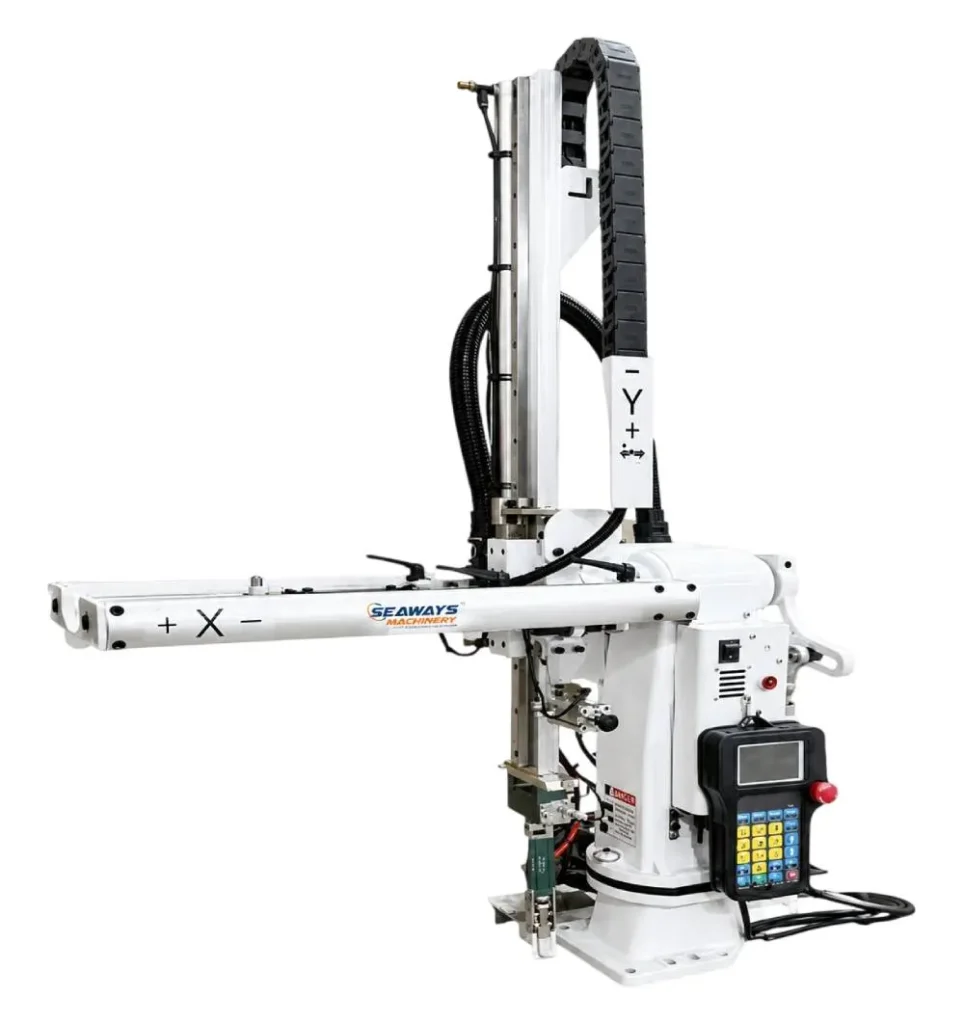
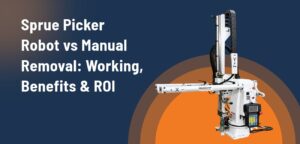
A sprue picker robot is a compact pick-and-place unit mounted on the fixed platen of the injection moulding machine. It combines vertical motion with a horizontal swing arm, and buyers typically specify both the swing angle and whether it swings towards the operator side or the rear.
Most entry-level pickers used in India are pneumatic, meaning compressed air drives all the movements. Here is one cycle, step by step:
- Mould opens. The machine sends a “mould open complete” signal to the picker.
- Arm descends. The vertical arm drops between the open mould halves.
- Arm moves in and grips. It moves crosswise towards the moving half, and the pneumatic gripper closes on the sprue.
- Ejection and pull-out. The picker allows the ejectors to move forward, then draws the sprue off the sprue puller.
- Arm rises and swings. The arm lifts clear of the mould and swings out, usually 30° to 90°.
- Release. The gripper opens and drops the sprue into a bin, chute or directly into a granulator for regrinding.
- Mould close permission. Once the arm is safely out, the picker tells the machine it may close the mould. The next cycle begins.
This two-way “handshake” is the key safety feature. The machine cannot close while the arm is inside, and the arm cannot enter until the mould is fully open. Larger servo robots often use the standard EUROMAP interface for this signal exchange, while simple pickers use a few dedicated signals.
A real example of specifications: Seaways’ APSP-650 model is rated for 30T to 150T machines, with a 650 mm vertical stroke, 120 mm crosswise stroke, 2 kg maximum load, 1.6 second dry take-out time, a 30–90° swing angle and air consumption of 3 NL per cycle.
For integration, it needs single-phase power, compressed air, and four signals: mould open end and safety door on one side, and mould close enable and ejector forward enable on the other. These numbers give you a useful checklist when comparing any brand.
Sprue Picker Robot vs Manual Removal: Comparison
| Factor | Manual Removal | Sprue Picker Robot |
| Machine mode | Semi-automatic | Fully automatic |
| Cycle consistency | Varies in every cycle | Same movement every cycle |
| Mould temperature stability | Fluctuates with door-open time | Stable |
| Rejection rate | Higher, especially at night | Lower and predictable |
| Operator safety | Low | High |
| Labour need | Usually one person per machine | One operator can watch several machines |
| Upfront cost | Nil | Investment required |
| Running cost | Wages every month | Compressed air, minor maintenance |
| Best for | Very short runs, frequent mould changes | Medium to long runs, multi-shift work |
Key Benefits of a Sprue Picker Robot
- Faster and steadier output. The robot removes the “human wait time” from the cycle. You can get up to a 10- 30% productivity gain over manual take-out.
- Better quality. Consistent mould-open time means consistent mould temperature. That directly reduces dimensional variation and cosmetic defects.
- Safer environment. Automated removal reduces the need for repetitive manual handling near the mould area. This helps minimise operator exposure to machine movements when the robot is properly integrated with the machine’s safety system.
- Lower labour dependency. Your helpers can be redeployed to packing, inspection or secondary operations. Night shifts become easier to staff.
- Mould protection. Reliable sprue removal every cycle protects expensive moulds from double-cycle damage.
- Cleaner scrap handling. Sprues drop into one fixed spot, making it easy to feed them straight to a granulator for regrinding.
- An easy first step into automation. A basic sprue picker can be a more economical starting point than investing in a sophisticated multi-axis robotic system. For manufacturers producing repetitive plastic components, it offers an opportunity to automate one of the most frequently repeated operations without redesigning the entire production line.
How to Calculate the ROI of a Sprue Picker Robot?
Let’s calculate payback for a typical scenario. All figures are illustrative assumptions, so replace them with your own.
The setup: One 120-tonne machine, a 4-cavity mould, two 12-hour shifts, 26 working days a month.
Labour cost basis: Gujarat’s Zone I minimum wage for unskilled workers is ₹500 per day. On average, we assume a helper costs about ₹15,000 per month.
Step 1: Investment
- Sprue picker: ₹1,10,000
- Transportation and Installation cost: ₹15,000
- Total: ₹1,25,000 (plus GST, which most registered businesses can claim as input credit)
Step 2: Labour saving
- Before: one helper per shift = 2 × ₹15,000 = ₹30,000/month
- After: one operator supervises 3 machines, so this machine’s share = ₹10,000/month
- Saving: ₹20,000/month
Step 3: Output gain
- Manual cycle: 30 seconds. About 20 productive hours a day gives 2,400 cycles.
- With a conservative 10% gain: 240 extra cycles/day
- At ₹0.40 contribution margin per part × 4 cavities = ₹1.60 per cycles
- 240 × ₹1.60 × 26 days = about ₹10,000/month (only if you have orders for the extra output)
Step 4: Reject reduction
- Assume rejects fall from 3% to 1.5%: about ₹3,000/month in material and rework
Step 5: Running cost
- Compressed air (about 3 NL per cycle) plus gripper and seal maintenance: about ₹1,000/month
Net monthly benefit: ₹20,000 + ₹10,000 + ₹3,000 − ₹1,000 = ₹32,000
Formula to use for your own plant: Payback (months) = Total investment ÷ (Monthly labour saving + Monthly output gain + Monthly reject saving − Monthly running cost)
When Manual Removal Still Makes Sense
A sprue picker is not the right answer everywhere. Manual removal may still be practical if:
- You run very short batches with mould changes several times a day.
- Your moulds are hot runner and parts free-drop reliably.
- The parts need careful handling, placement or insert loading. In that case, a servo take-out robot is the better choice.
- The machine runs only a few hours a week.
Important Factors to Consider Before Installing a Sprue Picker
Before selecting a robot, production and engineering teams should evaluate the following parameters.
- Injection moulding machine tonnage: Check whether the picker is compatible with the machine’s clamping capacity and physical configuration.
- Maximum payload: Calculate the combined weight of the components, runner and any additional gripping arrangement.
- Mould dimensions and clearance: Verify sufficient space for the robot arm to enter, extract and return safely.
- Cycle time: Ensure that the robot can complete its removal sequence within the available mould-open period without affecting production.
- Gripping arrangement: Select suitable gripping technology according to the product material, shape, weight and surface requirements.
- After-sales support: Consider spare parts availability, installation assistance, technical support and operator training.
Conclusion
Manual part removal looks cheap because there is no upfront cost of the machine. But you pay for it every month through wages, slower cycles, higher rejects and safety risks. A sprue picker robot replaces that variable human step with a consistent, safe and measurable one. For most Indian moulders running two shifts on machines, the payback is measured in months.
The smartest approach is to run the ROI formula above with your own numbers. If you’d like help matching a picker to your machine, mould and layout, we are here to help you. We are a Rajkot-based sprue picker robot manufacturer for 30T to 150T machines and offer technical consultation, installation and after-sales support across India.
You May Also Like: