Every factory makes two things. The product you sell, and the heat you never asked for. Injection moulds hold heat. Motors hold heat. And when that heat has nowhere to go, your cycle time gets longer, your parts warp, and your machines wear out early.
This is the problem that runs almost every factory in India. And most people blame the machine, the material, or the operator when the real culprit is the heat from the process.
That is exactly the job of an industrial water chiller. It is not a luxury add-on. In most processes, it is the difference between a good part and scrap.
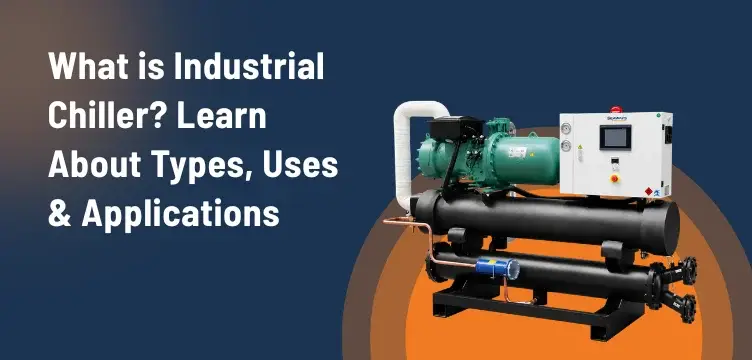
An industrial water chiller is the machine that takes the heat out of your process and dumps it outside repeatedly, all shift long, without letting the temperature get too high.
Let’s learn about what a chiller is, how it works, the types available, and where it is used.
Key Takeaways:
- A chiller is not an add-on. It removes the heat your machine creates and holds one steady water temperature, shift after shift, regardless of the weather outside.
- Cooling is 60-70% of an injection moulding cycle. Drop the mould temperature and the part solidifies faster, more cycles per hour from the same machine. This alone often pays for the chiller.
- Air-cooled vs water-cooled is decided by your site, not your budget. Air-cooled suits 2-20 TR, water-scarce sites, and open sheds. Water-cooled suits of 20 TR+, enclosed halls, and 3-shift runs where efficiency compounds.
- The compressor brand is the single most important spec. Tecumseh, Copeland or Danfoss means spares stay available and any local technician can service it. If a supplier won’t name the brand, that’s your answer.
- Oversizing costs you twice. An oversized chiller short-cycles, which makes the compressor keep switching on and off, wasting power, holding temperature poorly, and wearing out early. You pay more at purchase and more every month.
- Check kW, not just TR. Two 5 TR chillers can draw very different power. Intelligent power regulation matches energy use to real demand; that’s what shows up on the electricity bill.
- The small stuff protects the big investment. Clearance for airflow, insulated chilled-water lines, an SS304 pump instead of mild steel, and a clean condenser coil.
What Is an Industrial Water Chiller?
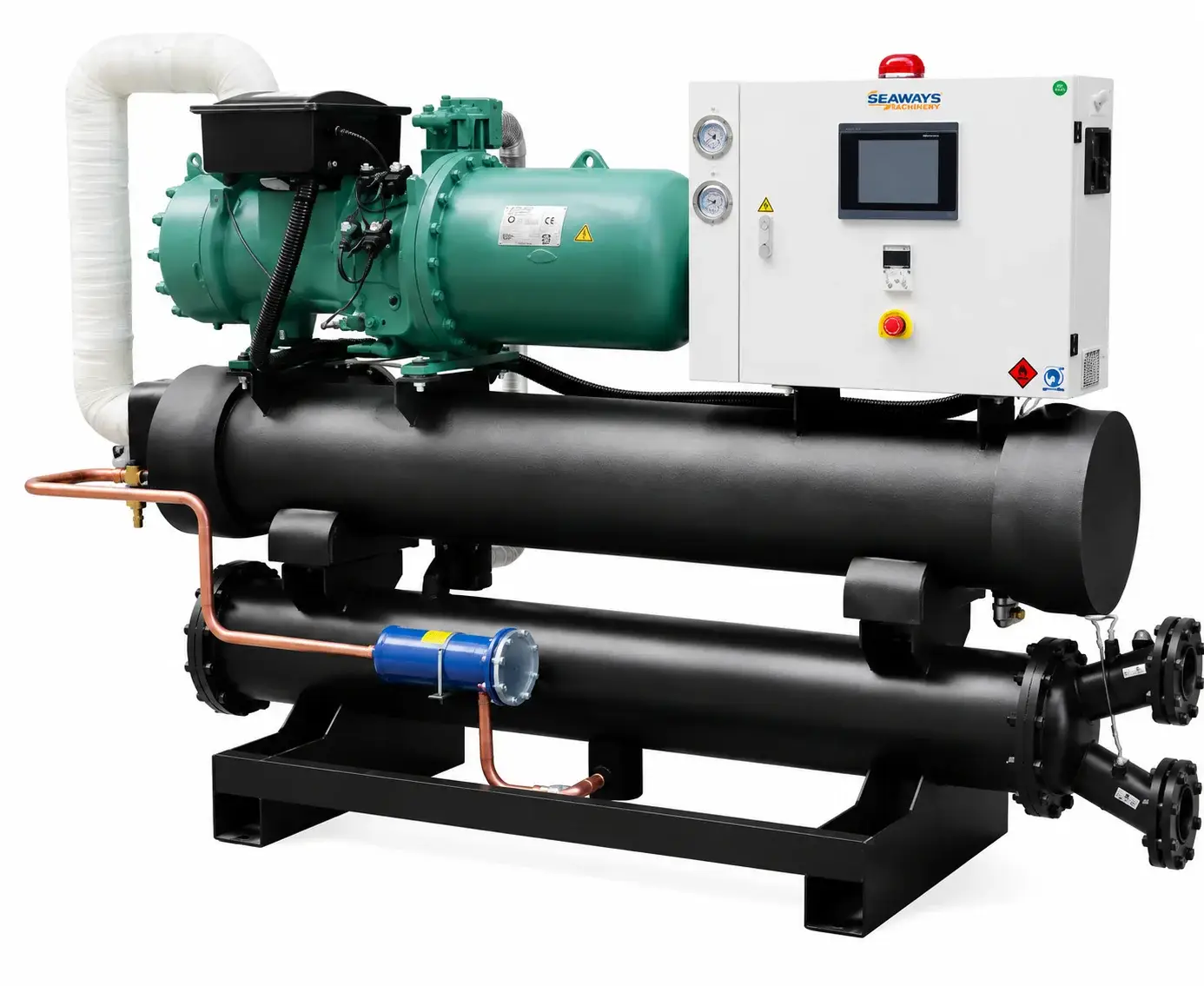
An industrial water chiller is a cooling machine that removes heat from water (or a water–glycol coolant) and then sends that cold water to your machine, mould, or process line.
Think of it as a fridge for your factory. But instead of cooling air inside a box, it cools water inside a tank, and that cold water does the real work.
A simple way to picture the loop:
- Warm water comes back from your machine into the chiller’s tank.
- The chiller pulls the heat out of that water.
- A pump sends the now-cold water back to the machine.
- The heat is thrown away, either into the air or into a separate water circuit.
- Repeat the process.
It is also called a process chiller, chiller machine, or industrial cooling system. The job is the same. Hold one steady temperature, no matter what the weather outside is doing.
How Does an Industrial Chiller Work?
Every chiller runs on the same four parts.
| Part | What it does |
| Compressor | The heart. It squeezes the refrigerant gas and pushes it around the loop. Brands like Tecumseh, Copeland and Danfoss are the trusted names here. |
| Condenser | Where the heat leaves the machine, into air (air cooled) or into water (water cooled). |
| Expansion valve | Drops the pressure suddenly, which makes the refrigerant go very cold. |
| Evaporator | Where the cold refrigerant meets your warm process water and takes the heat out of it. |
Add a water tank and an SS304 stainless-steel pump to circulate the chilled water, plus a temperature controller to hold your set point, and that is a complete industrial water chiller.
Types of Industrial Chillers
Chillers get classified in three ways. Buyers usually only care about the first one.
1. By How They Throw Away Heat
Air Cooled Chillers
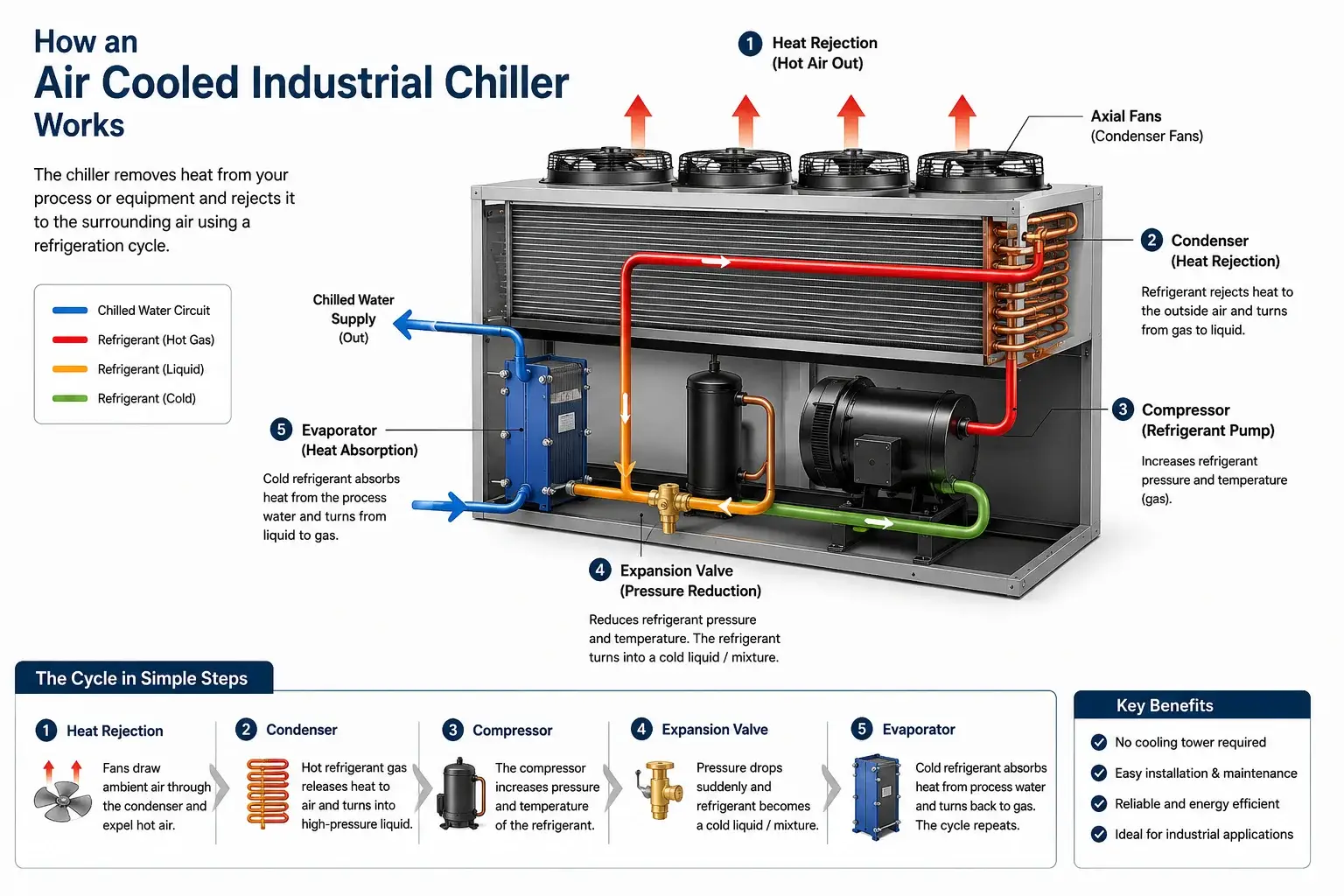
An air-cooled chiller uses fans to blow air over the condenser coil, pushing the heat directly into the surrounding air. No cooling tower. No water supply. No extra plumbing.
Best for:
- Units where a steady water supply is difficult or expensive.
- Small to medium plants (roughly 2 TR to 20 TR).
- Anyone who wants a plug-and-play install without building a cooling tower.
- Open sheds and rooftops with good airflow.
Advantages:
- No need for a cooling tower, water treatment, or pump house. Means lower installation cost.
- No water wastage or scaling problems.
- Easy to shift if you rearrange your plant.
- Lower maintenance — fewer parts to service.
Limitations:
- Needs good ventilation. Trap it in a closed corner and efficiency drops fast.
- Throws heat into your shed, makes a real consideration in summer.
- Fans make some noise.
Water Cooled Chillers
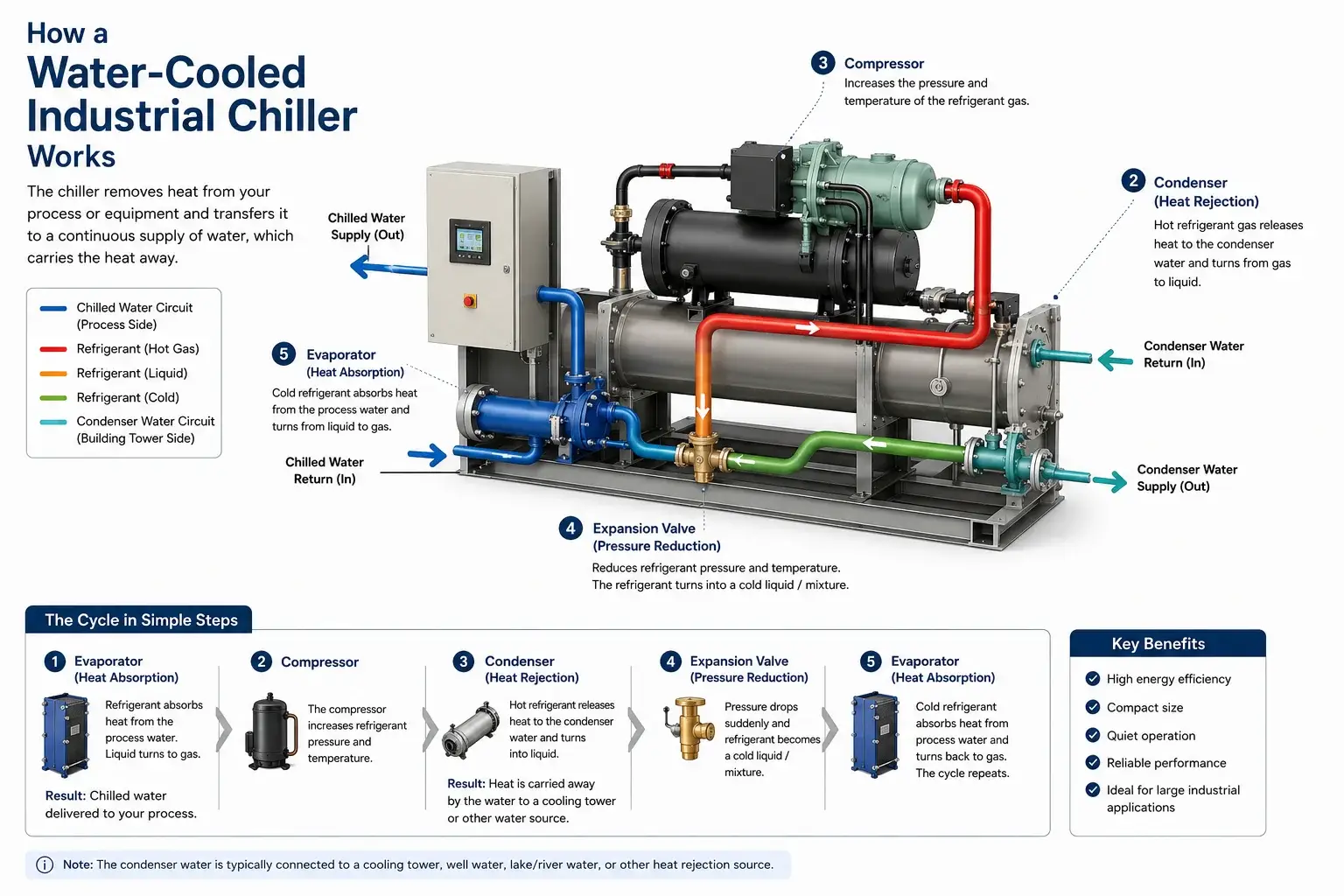
A water cooled chiller sends its heat into a separate water circuit, which usually runs to a cooling tower outside the building.
Best for:
- Larger cooling loads (typically 20 TR and above).
- Closed or air-conditioned production halls where you cannot dump heat inside.
- Plants that already have a cooling tower and water treatment in place.
- Continuous 3-shift operations where efficiency compounds into real savings.
Advantages:
- More efficient, especially in hot ambient conditions.
- Quieter.
- No heat is added to your factory.
- Generally, longer life, as the unit runs in a protected indoor space.
Limitations:
- Needs a cooling tower, pump, piping, and water treatment. Higher upfront cost.
- Water quality must be managed, or scaling will slowly kill your efficiency.
- Fixed installation, not easy to relocate.
Which One Should You Pick?
| Point | Air Cooled Chiller | Water Cooled Chiller |
| Heat goes into | Surrounding air | A water cooling tower |
| Water needed | No | Yes |
| Installation | Simple, fast | Needs tower + piping |
| Space | Needs open air around it | Needs tower space outside |
| Ambient effect | Performance dips in very hot air | Less affected by hot weather |
| Water treatment | Not needed | Needed |
| Best fit | Small–mid loads, water-scarce sites | Large loads, enclosed rooms |
For most plastic, moulding and general manufacturing units in India, an air cooled chiller is the practical choice. Water cooled makes sense when your load is big, or your machine room simply cannot take more hot air.
Seaways supplies both configurations, so the choice is driven by your site.
2. By Compressor Type
- Reciprocating / scroll compressors — the workhorses for small to mid-size industrial units. Reliable, easy to service, spares available anywhere.
- Screw compressors — used for very large central plant loads.
- Centrifugal compressors — huge capacity, mostly HVAC and heavy industry.
For most workshops and moulding units, a branded reciprocating or scroll compressor is exactly right.
3. By Design
- Packaged chiller — tank, pump, compressor and controls in one skid. Roll it in, connect, run. This is what most factories buy.
- Portable / spot chiller — smaller units moved between machines.
- Central chiller plant — one big system feeding the whole factory.
What Is an Industrial Chiller Used For?
On the industrial floor, a chiller does five real jobs:
- It cuts your cycle time. In injection moulding, cooling is 60-70% of the cycle. Drop the mould temperature and the part solidifies faster. Faster ejection means more production cycles per hour from the same machine. A chiller often pays for itself here alone.
- Protects part quality. Uneven cooling makes uneven shrinkage & low quality parts. Stable chilled water makes sure every part cools the same way. Make it possible to deliver consistent quality.
- It protects your machine. Hydraulic oil that runs too hot loses viscosity, damages pumps, and shortens seal life. Chilled water through the oil cooler keeps the hydraulics healthy for years.
- It makes quality repeatable. Your morning parts and your afternoon parts become identical. That is the whole point of the machine; the outside temperature stops mattering.
- It saves energy in the long run. A modern chiller with intelligent power regulation matches its energy draw to the actual cooling demand. It does not run at 100% when your line needs 40%.
Industrial Chiller Applications by Industry
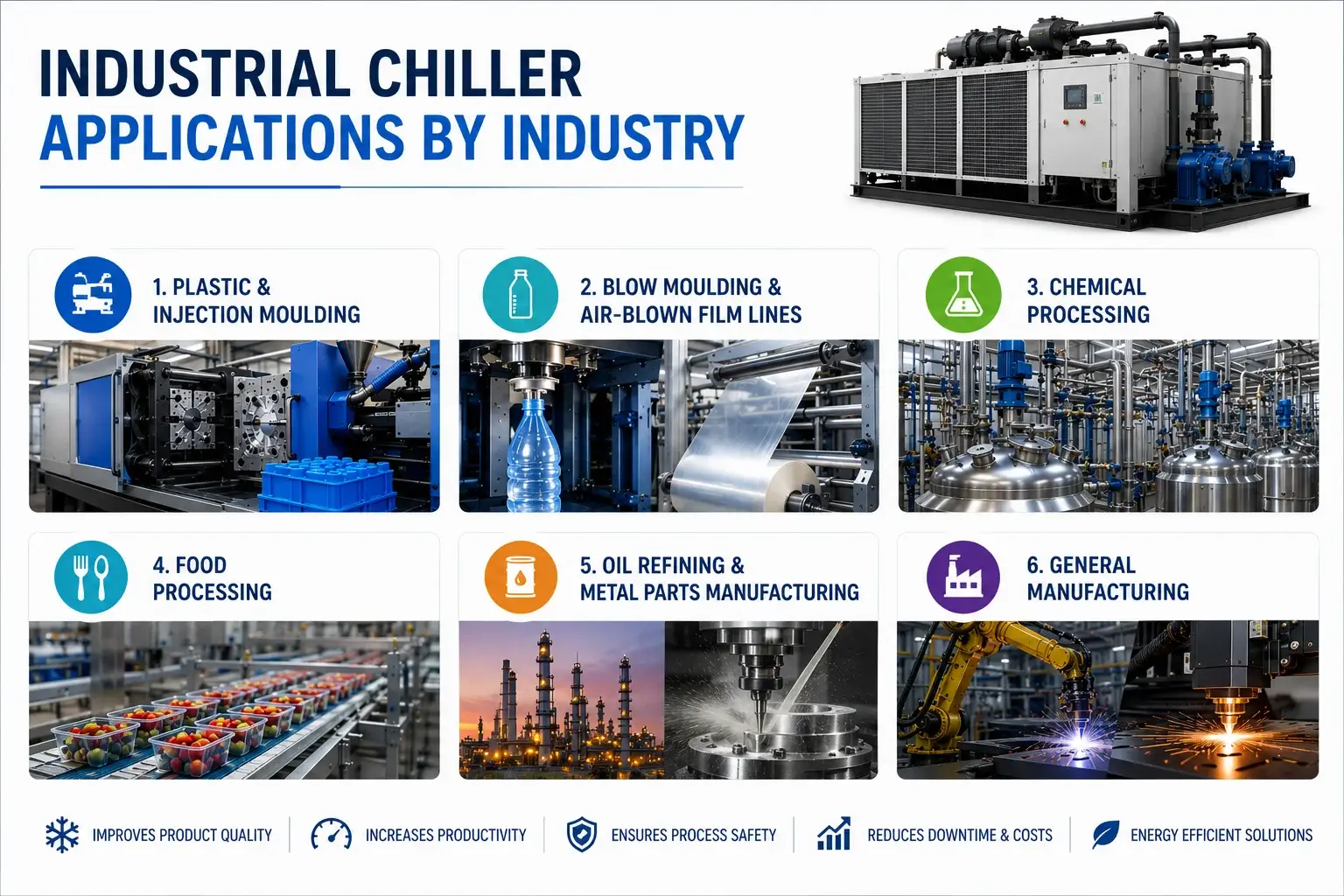
Plastic & Injection Moulding: The biggest user by far. Chilled water runs through the mould to set the part quickly and consistently. Faster cycles, better finish, fewer rejects.
Blow Moulding & Air-Blown Film Lines: Bottles, containers and film need controlled cooling as they form. Uneven cooling makes uneven wall thickness and scrap.
Chemical Processing: Many reactions release heat. A chiller pulls it away so the reaction stays safe and controlled and holds the storage temperature where it needs to be.
Food Processing: Cooling during production and preservation. Where a stable, hygienic chilled water line is non-negotiable.
Oil Refining & Metal Parts Manufacturing: Cooling for process equipment, machining, and metal-component production where heat build-up affects tolerances.
General Manufacturing: Anywhere a stable temperature is critical, such as welding, laser cutting, testing rigs, and tool rooms.
How to Choose the Right Chiller Capacity?
Chiller size is measured in TR (tons of refrigeration). 1 TR ≈ 3.5 kW of cooling.
Ask yourself these five questions before you buy:
- How much heat do you actually need to remove? For example, the rough rule for plastics is about 1 TR per 8-12 kg/hour of material throughput, depending on the polymer. But do not buy on a rule of thumb alone. Share your machine tonnage, material and per-cycle weight with the manufacturer’s technical team and let them size it.
- What temperature do you need? Most process cooling sits in the +10°C to +15°C range. Going colder needs a different design and costs more to run. Don’t over-specify.
- Air-cooled or water-cooled? Use the table above. Water availability and machine-room ventilation decide it.
- Have you sized for the future? Adding a machine next year? A slightly larger chiller is now cheaper than a second chiller later. But do not oversize wildly. An oversized chiller makes short cycles, and due to this, the compressor keeps switching on and off, which wastes power, causes poor temperature control, and wears out the compressor early. You pay more at purchase and more every month.
- Which compressor is inside? This is the single most important part. Insist on a branded compressor such as Tecumseh, Copeland or Danfoss. Spares stay available for years, and any local technician can service it. If a supplier will not tell you the compressor brand, you already have your answer.
Expert tips most buyers learn the hard way
-
- Give the chiller air to breathe. An air cooled unit jammed into a corner will trip in summer. Leave clearance around it.
- Insulate the chilled water lines. Uninsulated pipes gain heat and sweat all over your floor. It is a small cost that protects the whole investment.
- Watch the pump, not just the compressor. A cheap mild-steel pump rusts and clogs the loop. An SS304 stainless pump keeps circulation clean for years.
- Keep the water clean. Scale on the evaporator is like a blanket; the chiller works harder for less cooling, and your power bill quietly climbs.
- Check power draw, not just TR. Two 5 TR chillers can differ a lot in kW. Intelligent power regulation, where the unit matches energy use to real demand, is what shows up on your electricity bill every month.
- After-sales service matters. A chiller down for 10 days is not a chiller. Ask: Where is the nearest engineer? Are spares in stock? What is the warranty? These answers decide your real cost of ownership far more than the invoice does.
Chiller Maintenance Checklist
- Weekly — check water level, look for leaks, listen for odd compressor noise.
- Monthly — clean the condenser coil (air cooled units especially; dust is the #1 killer), check pump pressure.
- Quarterly — check refrigerant, clean the tank and strainer, inspect electricals.
- Yearly — full service by a trained technician, controller calibration.
Buying from a Direct Chiller Manufacturer
Buying from a factory rather than a trader cuts middleman costs, provides direct technical help while choosing, real spare parts, and one clear person responsible when something needs attention.
Seaways Machinery is an industrial water chiller and air cooled chiller manufacturer based in Rajkot, Gujarat, with 10+ years in plastic processing machinery. Every unit is factory-built and tested before dispatch.
Seaways Industrial Chiller Range (Water & Air Cooled):
| Model | Cooling Capacity | Compressor | Temperature | Power Supply | Weight |
| 2.5TR | 350 Litre | AW5535 Tecumseh | 10°C to 15°C | 380/450 W | 125 kg |
| 5.0TR | 750 Litre | 2R72 Copeland | 10°C to 15°C | 380/450 W | 210 kg |
| 7.5TR | 1100 Litre | Z108 Danfoss | 10°C to 15°C | 380/450 W | 290 kg |
| EN-2.5 IND | 8.8 kW | AW5535 Tecumseh | 10°C to 15°C | 380/450 W | 145 kg |
What you get across the range:
- Direct-cooling technology reaches the set temperature quickly.
- Branded compressors — Tecumseh, Copeland, Danfoss.
- SS304 stainless-steel pump for clean, reliable circulation.
- Intelligent power regulation — energy use matches real cooling demand.
- Both air cooled and water cooled configurations.
- 1-year warranty, spare parts availability.
- Pan-India delivery, installation, operator training and after-sales support.
📞 +91 99987 22228
👉 Get Your Model-Specific Quote
Final Thoughts
An industrial water chiller isn’t a comfort purchase. It is the machine that decides your cycle time, your reject rate and your power bill.
Get three things right and you’ll be happy for a decade: correct capacity, the right type for your site (air-cooled or water-cooled), and a branded compressor from a manufacturer who will still pick up the phone in year four.
Need help choosing between an air-cooled and a water-cooled chiller for your plant? Tell our technical team your cooling load and application, we’ll recommend the right model and send an exact quote within 4 business hours.
You May Also Like: