Key Takeaways:
- Two plants with the same number of machines can need very different chillers. The type of plastic matters, and so does how many kg per hour you produce. Many buyers also forget the hydraulic oil cooling load, which leaves the chiller undersized.
- Over a chiller’s life, electricity costs far more than the purchase price. The real deciding factor is how many hours your plant runs. For 24/7 production, a water-cooled system can pay back its higher price through lower power bills. For one or two shifts, air-cooled usually wins.
- In Indian summers above 42°C, an air-cooled unit loses capacity just as cooling demand peaks. If you choose air-cooled in a hot region, buy a model built for high temperatures and keep extra capacity as a buffer. Water-cooled systems handle heat better because cooling towers work on wet-bulb temperature, which stays lower than the actual air temperature.
- A water-cooled system constantly loses water through evaporation and blowdown. Hard water also leaves scale in the condenser tubes, and even a thin layer raises power use. If your water is scarce or hard and you won’t treat it, air-cooled is the safer choice, even if water-cooled looks better on paper.
- An air-cooled chiller in a closed room pulls its own hot exhaust back in, which hurts performance and heats up the factory. And it’s not an either-or decision. Many plants run a central water-cooled system for the main load plus a portable air-cooled unit for machines that need a different temperature.
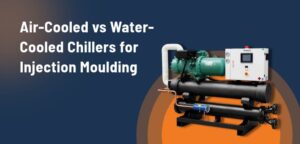
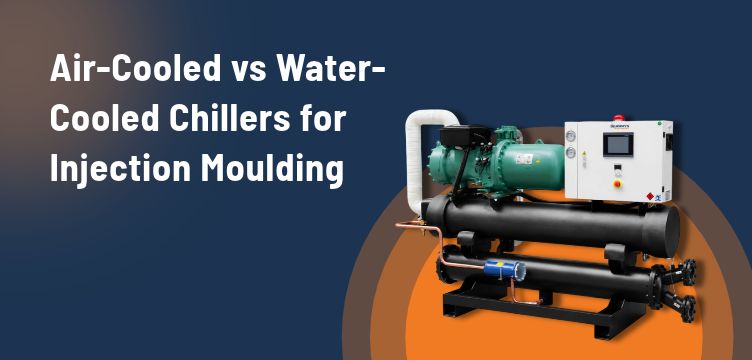
Choosing between air-cooled and water-cooled chillers for injection moulding depends on cooling load, climate, water availability, operating hours, and budget.
An air-cooled chiller is usually the better choice for small to mid-size plants, single machines, and sites with limited water. They cost less upfront and are simple to install. Water-cooled chillers make more sense for larger plants with high cooling loads. They use less power per ton of cooling and stay stable even in peak summer.
Let’s walk through each one so you can make the call with confidence.
Why Does Injection Moulding Need a Chiller?
Molten plastic releases heat as it cools inside the mould. The part must become firm enough to eject without losing its shape. Inconsistent cooling can cause longer cycle times, warping, sink marks, dimensional variation, or rejected parts.
An industrial chiller removes heat from process water and circulates cooled water to the equipment. Because cooling is often the longest stage of the injection moulding cycle, stable cooling affects both productivity and part quality. mould channels, flow, filtration, pipe insulation, and target temperature matter too. Size the unit for the actual heat load, not just the number of machines.
What Is an Air-Cooled Chiller?
An air-cooled chiller removes heat from its refrigerant through a condenser and fans that release the heat into the surrounding air. The chilled water then circulates through the mould or other process equipment.
Main advantages of air-cooled chillers:
- Simpler installation: The unit does not need a cooling tower or a separate condenser-water loop, so installation is often easier.
- Lower water use: It does not require cooling-tower water for heat rejection. This can be useful where water is costly, scarce, or difficult to treat.
- Maintenance: There is no cooling tower or tower-water treatment to manage. All though the condenser coil, fans, pumps, and refrigeration heat-rejection loop still need service.
- Flexible placement: Installation near the line or outdoors may be possible if ventilation and manufacturer clearance requirements are met.
What should you consider?
Air-cooled chillers release heat into nearby air. In hot or poorly ventilated spaces, performance can fall and electricity use can rise. Leave enough clearance around the unit and prevent hot exhaust air from returning to the condenser.
Fans can create noise, and the unit needs room for airflow. For continuous production, compare power costs. Don’t assume a lower installation cost guarantees the lowest lifetime cost.
What Is a Water-Cooled Chiller?
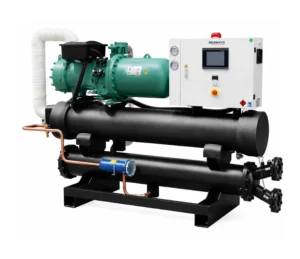
A water-cooled chiller transfers heat from its refrigerant to a separate condenser-water heat rejection loop. The water carries heat to a cooling tower or another heat-rejection system. The process water used for mould cooling is normally separate from this condenser-water heat rejection loop.
Main advantages of water-cooled chillers
- Energy savings: A well-designed tower and water-based heat rejection loop may use less electricity per unit of cooling at high loads.
- Continuous production: A central system can serve several machines operating long shifts.
- Reduced dependence on ambient air: Heat rejection depends on cooling-water conditions and tower performance rather than relying only on hot ambient air.
- Centralised layout: One planned system can supply multiple lines with suitable piping, controls, and capacity.
What should you consider?
A water-cooled system needs a cooling tower, condenser-water pump, piping, and often water-treatment controls. This adds installation work and space requirements. Tower water can be lost through evaporation and blowdown, while scale, corrosion, biological growth, and leaks require regular maintenance.
Pumps and tower fans also use electricity. So compare total system power, water costs, maintenance, and downtime risk before making any decision.
Air-Cooled vs Water-Cooled Chillers: Key Differences
| Factor | Air-Cooled Chiller | Water-Cooled Chiller |
| Initial cost | Often lower for a stand-alone setup | Often higher due to supporting equipment |
| Installation | Usually simpler | Needs tower, pumps, and additional piping |
| Energy efficiency | Good, but drops in hot weather | Higher, but more stable in long run |
| Maintenance | Fan, coil, pump, and refrigeration checks | Chiller, tower, pumps, water quality, and piping checks |
| Heat rejection | Releases heat to surrounding air | Transfers heat to condenser water, usually rejected through a cooling tower |
| Best fit | Small to medium plants, limited water, simpler layouts | High-load or multi-machine plants with existing water infrastructure |
5 Factors to Check Before Buying an Industrial Chiller
1. Cooling Load and Plant Size
Start with your total heat load. This depends on the number of machines, the type of plastic, your output in kg/hr, your target mold temperature, and any hydraulic oil cooling. Materials like PP and HDPE generally need more cooling per kilogram than ABS or polystyrene. As a general guide, smaller loads spread across a few machines often suit air-cooled units, while large central cooling systems usually get better long-term value from water-cooled chillers.
2. Your Local Climate
Air-cooled chillers depend on outside air, so the hotter it gets, the harder they work. In many parts of India, summer temperatures cross 42°C, and an air-cooled unit can lose noticeable capacity right when you need it most. If you choose air-cooled in a hot region, pick a model built for high ambient temperature and keep some capacity margin. Water-cooled systems are less affected because cooling towers work on wet-bulb temperature, which stays below the actual air temperature.
3. Water Availability and Quality
A cooling tower keeps losing water to evaporation and blowdown, so you need a reliable source of water. Water quality matters just as much. Hard water with high TDS leaves scales inside condenser tubes, and even a thin layer pushes up power consumption. If water is scarce or hard and you don’t plan to treat it, air-cooled is the safer option.
4. Space and Installation
Air-cooled chillers need open space with good airflow. Placing one in a closed room or a congested space lets hot air circulate back into the unit, which lowers performance. Installed indoors, it also adds heat to your factory. A water-cooled chiller is compact and can be installed inside, but the cooling tower needs outdoor space, along with pumps and piping.
5. Energy Cost & Total Cost of Ownership
Electricity is the biggest cost over a chiller’s life, often far more than the purchase price. A water-cooled system that costs more upfront can pay for itself through lower power bills in a plant running 24/7. For a plant running one or two shifts on a modest load, the lower investment of an air-cooled chiller often comes out ahead.
6. Maintenance Capacity
Air-cooled units mostly need regular coil cleaning, filter checks, and fan inspections. Water-cooled systems need ongoing water treatment, periodic descaling, and cooling tower maintenance. Be honest about what your maintenance team can realistically handle.
Which Chiller Is Better for Your Injection Moulding Factory?
Go with an air-cooled chiller if:
- You run a small or mid-size plant with a few machines.
- Water is limited or very hard.
- You want a quick installation with fewer components.
- You may need to move the chiller between machines.
- Your upfront budget is tight.
Go with a water-cooled chiller if:
- You run many machines from a central cooling system.
- Your plant works round the clock.
- You already have a cooling tower or plan to add one.
- You need steady capacity through hot summers.
- Lower running cost matters more than upfront cost.
Many plants use both. A central water-cooled system handles the main load, while a portable air-cooled chiller serves a machine that needs a different water temperature or tighter control.
Do You Need a Chiller or a Mould Temperature Controller?
These machines seem related but do very different jobs. An industrial chiller produces chilled water for process cooling. A mould temperature controller (MTC) circulates fluid through the mould and controls its temperature, sometimes heating it as well as cooling it. Making your arrangement depends on the plastic material, mould temperature, and process requirements.
Read Seaways’ guide to the mould temperature controller to understand how these systems work together.
Common Mistakes to Avoid
- Choose the chiller only based on the number of machines alone and ignoring material and throughput.
- Forgetting the hydraulic oil cooling load.
- Leaving no margin for peak summer temperatures.
- Skipping water treatment on a water-cooled system.
- Installing an air-cooled unit where hot air cannot escape.
Find the Right Industrial Chiller for Your Process
The right chiller helps maintain stable temperatures, consistent parts, and dependable production. Air-cooled models generally suit plants that need simpler installation; water-cooled models can suit high-load operations with the right infrastructure.
Seaways Machinery supplies industrial chillers for plastic processing. Explore the Seaways industrial chiller range or share your capacity, process temperature, machine details, and factory conditions to discuss a suitable option.
You May Also Like: