Every plastic factory runs on one simple thing. Material must reach the machine on time, in the right quantity, and in clean condition. If that does not happen, the moulding machine stops. Operators start carrying buckets by hand. Material spills on the floor. Reject rates go up.
This is exactly the problem that feeding and conveying systems solve.
In this guide, we explain what these systems are, the different types available, how to choose the right one for your plant, and what you should expect to spend.
Key Takeaways
- Feeding and conveying systems automatically move granules, powder, regrind or flakes from storage to the moulding machine through closed pipes, replacing manual feeding.
- Seven main types cover most plants: vacuum hopper loader, separate vacuum loader, Euro loader, drying loader, central distribution system, screw conveyors, and belt/bucket conveyors.
- Selection depends on five facts: material type, hourly consumption, conveying distance and bends, number of material changes, and whether drying is needed.
- Always size for 25-30% extra capacity so the loader isn’t running continuously.
- Weekly ten-minute filter cleaning prevents roughly 80% of conveying complaints.
- Buying direct from the manufacturer typically saves 15-20% and speeds up spare-part support.
- Most plants recover the investment within months through lower labour cost, less wastage and higher uptime.
What Are Feeding and Conveying Systems?
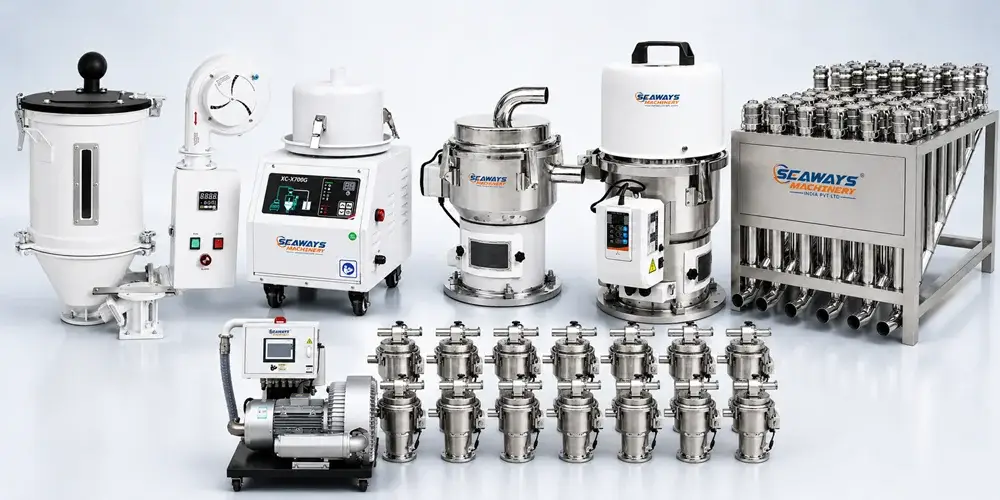
Feeding and conveying systems are machines that automatically move plastic raw materials, such as granules, powder, regrind, or flakes, from a storage point to the processing machine.
The storage point could be a bag, a drum, a silo or a mixer. The processing machine could be an injection moulding machine, an extruder, a blow moulding machine or a pipe plant.
Instead of a worker lifting a 25 kg bag onto a platform and pouring it into the hopper, a conveying system pulls the material through a pipe using suction and drops it straight into the machine hopper. The system starts and stops on its own based on a level sensor.
Why Feeding and Conveying Systems Matter
Many small and mid-size plants still feed material manually. They think automation is a big expense. But in reality, manual feeding costs money every single day. Here is what a proper conveying system gives you:
- No machine starvation
The hopper never runs empty. The moulding machine keeps running at full cycle without waiting. - Less labour cost
One operator can handle four or five machines instead of standing at one machine with a bucket. - Cleaner material
Material travels inside a closed pipe. No dust, no floor contamination, no moisture pickup from open bags. - Better product quality
Consistent feeding means consistent melt, consistent shot weight and fewer short shots or flow lines. - Safer factory floor
No worker climbing on a stool with a heavy bag near a hot machine. - Less material waste
Spillage during manual pouring is real. Over a year, it adds up to thousands of rupees of lost granules.
Main Types of Feeding and Conveying Systems
Different plants need different equipment. Below are the most common types used in the plastic industry.
1. Vacuum Hopper Loader
This is the most common machine in the category. A motor creates vacuum, sucks material through a flexible pipe, collects it in a small hopper mounted on top of your machine, and then drops it in.
Best for: Injection moulding and extrusion plants running one or two materials per machine.
2. Separate Vacuum Hopper Loader
In a separate vacuum hopper loader, the motor and blower unit sit away from the hopper, usually on the floor or wall. This reduces vibration and noise on top of the machine and makes maintenance easier.
Best for: Taller machines, cleanroom-type setups and plants where multiple hoppers share one vacuum source.
3. Euro Loader
Euro Loader is a compact, self-contained loader with a built-in motor, filter and control. It is quick to install and popular where floor space is limited.
Best for: Small to medium plants that want a plug-and-play solution.
4. Drying Loader
The drying loader is a two-in-one machine. It conveys the material and dries it at the same time using hot air. Very useful for moisture-sensitive materials like PET, PA (nylon), ABS and PC.
Best for: Plants that need drying but do not have space for a separate hopper dryer.
5. Central Material Distribution System
Instead of one loader per machine, a central station stores several materials in silos or bins and distributes them to many machines through a network of pipes and valves.
Best for: Large plants with 10 or more machines, or plants doing frequent material changes.
6. Screw Conveyors and Flexible Screw Feeders
These use a rotating screw inside a tube to push material forward. They handle powders, masterbatch and difficult free-flowing materials well.
Best for: PVC compounding, powder handling and mixer feeding.
7. Belt and Bucket Conveyors
Mechanical conveyors that carry scrap, flakes or regrind from a grinder to a storage bin or washing line.
Best for: Recycling plants and grinder outlet handling.
How a Vacuum Conveying System Works: Step by Step
Understanding the working cycle helps you troubleshoot faster.
- The level sensor in the machine hopper detects that material is low.
- The control panel starts the vacuum motor.
- Suction is created inside the loader hopper.
- Material is pulled from the source through the suction pipe along with air.
- Filter and separator keep material inside the hopper and let clean air pass to the motor.
- Motor stops after a set time or when the hopper is full.
- Discharge flap opens by gravity and material falls into the machine hopper.
- Filter cleaning happens automatically by a reverse air pulse or shaker.
The whole cycle takes only a few seconds and repeats hundreds of times a day.
How to Choose the Right Feeding and Conveying System
Ask yourself these questions before buying.
What is your material?
Free-flowing virgin granules are easy. Regrind, flakes, powder and glass-filled compounds behave differently and need different hopper angles, filters and pipe sizes.
What is your hourly consumption?
Add up the throughput of every machine that will be connected. Always keep 25-30% extra capacity so the loader is not running non-stop.
How far is the material source?
Conveying distance and the number of bends decide the motor power you need. A 3-metre lift is very different from a 25-metre horizontal run with four bends.
How many materials do you handle?
If you change material two or three times a week, choose a system that is easy to clean. Quick-release clamps and openable hoppers save a lot of time.
Do you need drying too?
If your material is hygroscopic, plan drying and conveying together instead of buying them separately later.
What is your power supply?
Confirm voltage and phase. Also check the panel; a good system should have overload protection, dust-level alarm and auto filter cleaning.
Common Problems and Simple Fixes
| Problem | Likely Cause | Fix |
| Loader not picking material | Choked filter or air leak in pipe | Clean filter, check clamps and gaskets |
| Material stuck in pipe | Too many bends or low motor power | Reduce bends, upsize motor |
| Dust reaching motor | Torn filter bag | Replace filter |
| Hopper overflows | Level sensor fault | Clean or replace sensor |
| Noisy operation | Loose mounting or worn bearing | Tighten mounting, service motor |
A ten-minute weekly filter cleaning routine prevents about 80% of all conveying complaints.
Maintenance Checklist
- Daily: Check for material leakage and unusual sound.
- Weekly: Clean filter bag or cartridge; check pipe clamps.
- Monthly: Inspect suction hose for cracks and wear at bends.
- Quarterly: Check motor carbon brushes, seals and gaskets.
- Yearly: Full service of blower, control panel and sensors.
Price Range in India
Prices depend on capacity, motor rating, conveying distance and material type. As a rough guide:
- Euro Loader: starting around ₹40,000
- Drying Loader: starting around ₹29,000
- Separate Vacuum Hopper Loader: varies by motor HP and hopper size
- Central Distribution System: project-based pricing after site study
Buying directly from a manufacturer instead of a trader usually saves 15-20% and gives you faster spare part support.
Conclusion
Feeding and conveying systems are the backbone of a smooth plastic production line. Your moulding machine can be world-class and your mould perfectly built, but if material does not reach the hopper on time and in clean condition, none of that helps.
The good news is that this is one of the easiest problems to fix. There is a system for every plant size. A compact Euro loader for a single machine, a drying loader where moisture is the issue, or a central distribution station for a full plant.
Just choose based on facts. Know your material, hourly consumption, conveying distance and future expansion before buying. Most plants recover the cost within months through saved labour, less wastage and higher uptime.