Key Takeaways:
- A powerful motor won’t guarantee fast output if you are using a fine mesh screen, because plastic takes much longer to cut down and pass through.
- Sizing a machine based on your total daily scrap will cause massive backups during high-volume production hours; you must calculate capacity based on peak generation times.
- Buying a larger HP machine “just in case” inflates your upfront equipment costs, wastes electricity during light runs, and takes up valuable shop floor space.
- A high-horsepower motor is useless if large sprues, runners, or thick lumps cannot pass into the cutting chamber or feed hopper properly.
- A grinder’s actual hourly output depends heavily on how scrap enters it. Manual feeding causes uneven processing spikes, whereas conveyor or automated feeding keeps output steady.
- Running a machine for multiple long shifts causes rapid wear on blades and bearings, meaning serviceability and spare parts access matter far more than the initial sticker price.
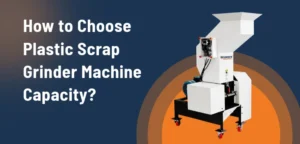
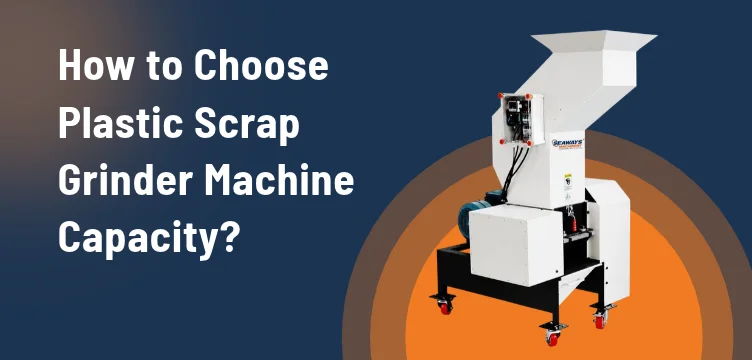
Choosing a plastic scrap grinder is not simply about buying a higher horsepower motor. The right plastic scrap grinder capacity depends on four things.
- How much scrap you process per hour
- what type of plastic you grind
- the required regrind size, and
- how many hours the machine will run.
As a practical starting point, 5-10 HP suits small applications, 15-20 HP fits medium-duty work, and 25-30 HP is intended for higher-throughput industrial grinding. Keep about 25-30% spare capacity so the grinder is not running at its limit.
A small grinder can become a bottleneck, while an oversized machine can add unnecessary cost. This guide explains how to match grinder capacity with your production needs.
Plastic Scrap Grinder Capacity: Selection Guide
A plastic scrap grinder converts production waste into reusable regrind, but choosing the wrong capacity can cause overloading, delays, or unnecessary operating cost.
For a 5 HP to 30 HP plastic scrap grinder, do not select the machine by motor HP alone. Chamber size, blade design, mesh size, plastic type, scrap thickness, and feeding method also affect the actual kg/hr output.
| Motor size | Typical application | Starting range* |
| 5 HP | Small business, sprues and runners | 50-150 kg/hr |
| 10 HP | Small-to-medium plastic processing | 100-200 kg/hr |
| 15 HP | Medium-size production scrap | 150-300 kg/hr |
| 20 HP | Higher-volume production scrap | 250-400 kg/hr |
| 25 HP | Industrial plastic recycling | 350-500 kg/hr |
| 30 HP | Heavy-duty, high-volume grinding | 450-600 kg/hr |
*These are selection ranges, not guaranteed outputs. Actual capacity depends on material, scrap size, thickness, mesh size, blade condition, and machine design.
1. Start with Your Required kg/hr
First calculate how much scrap you really need to process in one hour. Measure scrap generation over several production days.
For example, if a plant generates 240 kg of scrap in an eight-hour shift, the average load is 30 kg/hr. If it must process 300 kg in three grinding hours, the required rate is 100 kg/hr.
Your finished-product output may be high, but the grinder only needs to handle the scrap. Also consider peak loads and accumulated stock. This simple calculation gives you a much clearer starting point when comparing a plastic grinder machine or industrial plastic recycling machine.
2. Choose 5 HP for Small Scrap Handling
A 5 HP plastic scrap grinder is often suitable for small recycling factories and in-house processing of sprues, runners, small molded parts, and light production rejects.
It can be a practical option when scrap volume is modest and the machine does not need to run at a very high rate for long periods. Our 5 HP machine is available in 12-inch and 14-inch models, with different stated capacities. This shows why HP should always be checked together with chamber size.
Choose 5 HP when your scrap is relatively small, the pieces are manageable in size, and space or power availability is limited.
A small scrap grinder machine can also be useful beside injection molding equipment because sprues and runners can be ground and prepared for reuse instead of being collected as waste.
3. Consider 10-15 HP for Medium-Size Processing
A 10 HP or 15 HP plastic grinder can suit processors with a larger waste stream, such as packaging scrap, molded articles, and production rejects.
Give the manufacturer exact material details. Confirm expected kg/hr for your plastic, maximum thickness, and mesh size rather than comparing machines only by motor power.
The required output size matters too. A grinder producing coarse regrind may process material differently from one designed for a finer screen. Your plastic grinding machine should therefore be selected around the complete application.
4. Move to 20 HP for Higher Throughput
A 20 HP plastic scrap grinder is a useful choice for medium-to-large processors that need faster handling of a steady scrap flow. But first check electrical supply, floor space, feeding, and regrind collection. The grinder should not be faster than the upstream or downstream handling system.
For plants with regular production scrap, this capacity can help reduce waiting time and keep material moving through the recycling process.
5. Choose 25 HP for Larger Industrial Loads
A 25 HP plastic scrap grinder makes sense when grinding becomes an important part of the recycling or production workflow rather than an occasional support task. Also check blade material, sharpening access, screen replacement, safety interlocks, and service support because these affect uptime.
At this capacity, the machine may become part of a larger recycling setup. Good material feeding, regular blade maintenance, and correct screen selection can make a major difference to actual output.
6. Select 30 HP for Heavy-Duty Grinding
A 30 HP plastic scrap grinder is generally considered when scrap volume is high and the machine will be used frequently or for long shifts. Choose this machine only when the plant has a high waste stream, sufficient electrical capacity, enough space, and feeding support.
For a small waste stream, however, 30 HP may add cost without adding useful productivity. Bigger is not always better when the actual scrap load is low.
HP is Not the Same as Grinder Capacity
One of the most important points in plastic scrap grinder selection is that motor HP does not equal guaranteed output.
Motor HP tells you about motor power, but actual grinding capacity depends on the complete cutting system. Chamber width affects feed volume. Blade geometry affects cutting action. Mesh size controls when material can leave the chamber. Plastic density, shape, thickness, and contamination also change performance.
A fine mesh can reduce throughput because material needs more cutting before it exits. Chamber size also matters. That is why you should ask for expected kg/hr for your actual material and mesh size, not only the motor HP.
Key Factors Before Buying a Plastic Scrap Grinder Machine
1. Material Type and Thickness
Tell the plastic scrap grinder machine manufacturer exactly what you grind and the maximum wall or lump thickness. Soft plastics and rigid plastics can require different cutting conditions.
2. Required Regrind Size
Mesh size affects both particle size and output rate. Choose the screen according to your next process, whether you plan to reuse the regrind in injection molding, extrusion, compounding, or plastic recycling.
3. Daily Operating Hours
A grinder used for occasional in-house recycling has a different requirement from one running multiple shifts. Frequent use makes build quality, blade life, bearings, cooling, and service support more important.
4. Feeding Method
Manual feeding, conveyor feeding, and automatic feeding create different operating conditions. Match the hopper and cutting chamber to the way scrap reaches the machine.
5. Future Growth
Do not size the machine only for today. We recommend keeping roughly 25-30% extra capacity to handle peak loads and reduce the risk of the grinder becoming a bottleneck.
Simple Plastic Grinder Capacity Formula
Use this formula:
Required grinder capacity = Total scrap to process ÷ Available grinding hours
Then add a practical buffer.
Example:
300 kg of scrap ÷ 3 grinding hours = 100 kg/hr
With a 25% buffer:
100 × 1.25 = 125 kg/hr
So, compare machines that can reliably deliver around 125 kg/hr for your material. Do not choose a grinder just because its HP rating looks suitable.
Common Mistakes in Grinder Capacity Selection
- One common mistake is choosing the lowest HP because the scrap volume seems small. Another is buying the largest model “for future use” without checking energy, space, and actual utilization.
- Ignoring mesh size is another problem. A grinder set for finer output may not achieve the same kg/hr as one using a larger screen.
- Finally, do not overlook spare blades, screens, maintenance access, and technical support. Wear parts directly affect uptime, especially in multi-shift applications.
Final Buying Checklist
Before buying a plastic scrap grinder machine, prepare these details:
- Plastic type
- Maximum scrap thickness
- Average kg/hr
- Required mesh size
- Daily operating hours
- Electrical supply
- Feeding method
Then ask the manufacturer to confirm the expected output for your specific material. Don’t ask a question like, “How many HP do I need?” Ask, “How much scrap must I process, what regrind size do I need, and how hard will the grinder work?”
That approach helps you avoid both under-sizing and over-sizing and makes your plastic grinder machine investment more practical.
For a model-specific recommendation, review the Seaways Plastic Scrap Grinder Machine range and share your material, hourly requirement, and operating schedule.
You May Also Like: