Key Takeaways:
- A plastic scrap grinder is best for thin to medium plastic scrap, while a plastic crusher is designed for thick, bulky, and hard plastic waste.
- Don’t choose a machine based on its name alone. Always compare the rotor size, blade type, screen size, motor power, and actual output capacity.
- The quality of the regrind affects your final product, recycling efficiency, and overall production costs.
- Match the machine to your plastic type, scrap thickness, and hourly production volume for the best performance.
- If you process both thin and thick plastic waste, using a crusher before a grinder often gives the best results.
- Always ask the manufacturer to test the machine with your own scrap before making a purchase.
Plastic waste is an unavoidable part of every manufacturing process, whether it comes from sprues, runners, rejected parts, purge lumps, or cut film. Instead of selling this scrap at a low value, many manufacturers choose to recycle it in-house to reduce material costs and improve production efficiency.
However, selecting the right recycling equipment is not as straightforward as it seems. You’ll often come across terms like scrap grinder machine, plastic crusher machine, and plastic granulator, sometimes used interchangeably despite differences in design, performance, and application.
Choosing the wrong machine can lead to higher energy consumption, frequent blockages, inconsistent regrind quality, and unnecessary operating costs.
This guide breaks down the differences between these machines in simple terms, helping you understand which option best suits your material type, production volume, and recycling requirements.
Why This Choice Is Important
Grinding is the first step of every recycling line.
Whatever comes out of your grinder for plastic scrap decides everything after it. How well the material flows, how it melts, and how good your final granule or product is. Bad regrind cannot be fixed later.
The money side is also big. As per the OECD Global Plastics Outlook, plastic waste has more than doubled, and after losses during recycling, only 9% of plastic waste was actually recycled.
So scrap is not waste anymore. It is raw material with a price. Your machine decides how much of that price you keep.
What Is a Scrap Grinder Machine?
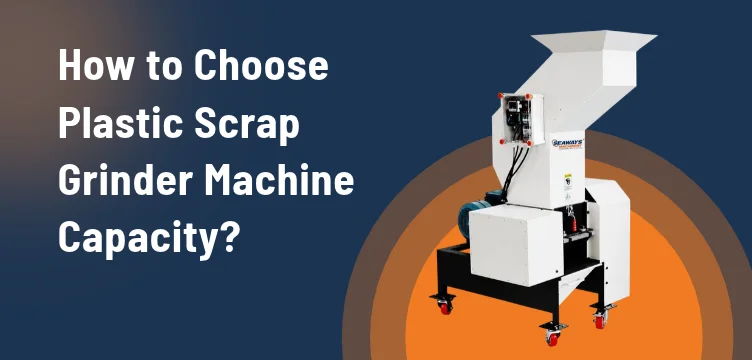
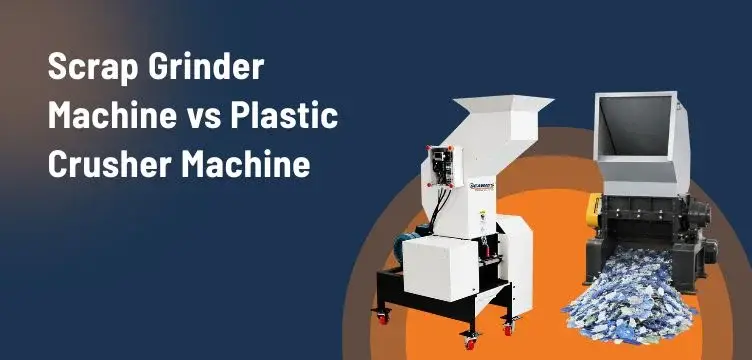
A plastic scrap grinder machine (also called a granulator) cuts plastic scrap into small, even pieces. It uses a fast-moving rotor with sharp blades.
How It Works
- Feeding – Scrap goes into the hopper.
- Cutting – Blades on the rotor pass very close to fixed blades. This gap is usually 0.15 to 0.30 mm. The plastic is cut like paper with scissors.
- Screening – Cut pieces fall on a screen with holes (6 mm, 8 mm, 10 mm or 12 mm). Bigger pieces stay inside and get cut again.
- Discharge – Regrind falls into a bin, or a blower lifts it to your hopper or silo.
Rotor speed: 400 to 700 RPM.
Cutting style: shearing (clean cutting).
Best For
- Injection moulding sprues, runners and reject parts
- Blow moulding bottles, cans and flash
- LDPE and HDPE film, bags, sacks and raffia tape
- PP, HDPE, LDPE, PS, ABS, PET and PVC parts
- Any unit that wants same-size regrind to mix with virgin material
What Is a Plastic Crusher Machine?
A plastic crusher handles the heavy stuff that a grinder cannot take. It runs slower but with much more power. It breaks material by hitting it, not by neatly cutting it.
How It Works
Heavy blades on the rotor hit the plastic against fixed plates inside a strong chamber. Because the rotor is heavy, it does not stop when a hard piece comes in.
The output is bigger and rougher. Many plants send this output to a grinder after that for final sizing.
Rotor speed: 300 to 500 RPM.
Cutting style: hitting and breaking.
Best For
- Thick pipes, fittings, drums and crates
- Big purge lumps from machine start-up
- Bumpers, pallets and moulded furniture
- Hard, thick and bulky scrap of any kind
Scrap Grinder Machine vs Plastic Crusher Machine: Simple Comparison
| Point | Plastic Scrap Grinder | Plastic Crusher |
| How it cuts | Fast, clean shearing | Slow, strong hitting |
| Rotor speed | 400-700 RPM | 300-500 RPM |
| Power (torque) | Medium | Very high |
| Output size | Even, 6-12 mm | Rough, 10-40 mm |
| Screen | Yes, standard | Optional, coarse |
| Scrap thickness | Thin to medium | Thick and bulky |
| Can output be used directly? | Yes | Usually needs grinding again |
| Dust | Low to medium | Medium to high |
| Noise | Lower | Higher |
| Motor | 10-50 HP | 30-150 HP |
| Blade wear | Medium | High |
| Price | Lower | Higher |
| Place in line | First (or second) | First stage only |
One Thing Most Buyers Get Wrong
Here is something we explain to almost every customer.
In India, the words grinder, crusher, and granulator are used loosely. Many sellers list the same 20 HP granulator as a “crusher” only because people search for that word.
So do not buy on the name. Buy on these four points:
- Rotor size (like 16″×16″, 20″×24″, 24″×36″)
- Rotor speed and blade type
- Screen hole size
- Motor HP against your real hourly output
Two machines with the same name can give very different output. The name tells you nothing. The rotor tells you everything.
How to Choose: 5 Easy Steps
Step 1 – Look at your scrap. Note the plastic type, wall thickness, how dirty it is, and whether it is hard, filmy, or foamy.
Step 2 – Fix your output in kg per hour. Not per day. If you make 2,000 kg a day in one shift, you need about 250 kg per hour.
Step 3 – Decide the size you want. Regrind going back to moulding usually needs 6 to 8 mm. Material going to a crusher machine can take 10 to 12 mm.
Step 4 – Match the machine. Need thin scrap, then choose grinder only. Need thick or mixed scrap, choose crusher first, then grinder. Need very high volume, then you need both machines with a conveyor.
Step 5 – Ask for a trial. Send your own scrap to the plastic scrap grinder machine manufacturer and ask for a video of the trial and the motor amperage reading. Good suppliers will do this happily.
Two Real Examples
Example 1: Injection Moulding Unit, Rajkot
A unit with 12 moulding machines made PP household items. Daily scrap was about 900 kg of sprues and rejects. A supplier told them to buy a heavy crusher.
The right choice was a 20 HP grinder with an 8 mm screen and a blower system. They mixed 25% regrind with virgin PP, saved around ₹18 to ₹22 per kg, and got their money back in less than seven months.
Example 2: PVC Pipe Maker, Ahmedabad
Reject pipes with 6 to 14 mm wall kept jamming a normal granulator. The motor tripped twice in every shift.
The right choice was two machines: a 50 HP crusher first, then a 30 HP grinder with a 10 mm screen. Daily stoppage came down from about 90 minutes to almost zero. Blade life also improved, because the grinder was no longer taking hard hits.
Costs People Forget
- Extra blade sets (always keep one spare set)
- Blade sharpening every 200 to 400 running hours
- Screens in different hole sizes
- Blower, cyclone and pipes
- Foundation, starter panel and wiring
- Safety guards and operator training
Common Mistakes to Avoid
- Buying on HP alone. Two 20 HP machines with different rotors give very different output.
- Ignoring blade steel. Ask for D2, D3 or HCHC blades with 58 to 62 HRC hardness. Soft blades cost you more in the long run.
- Wrong screen size. Very small holes cut your output badly and create heat and dust.
- Not checking the blade gap. If the gap is wrong, the plastic melts and sticks instead of cutting. This happens a lot with LDPE film.
- No dust system. Dust spoils the regrind and is bad for your workers.
- Choosing the cheapest quote. In a machine running 8 to 16 hours daily, poor build quality shows up by the third month.
Why Choose Seaways Machinery
As a trusted plastic grinder manufacturer in India, we build machines around your scrap, not around a standard catalogue page.
- Strong fabricated body with balanced rotors
- D2 and HCHC hardened blades that can be reversed and re-sharpened
- Screens from 4 mm to 16 mm
- Optional soundproof hopper, blower, cyclone and conveyor
- Trial with your own scrap before dispatch
- Installation, training and spares support all over India
See our plastic scrap grinder machine range or ask for a quotation with your scrap details.
You May Also Like: