Process cooling is one of the highest electricity consumers in any plastic processing plant. A typical injection molding setup spends 30-40% of its monthly electricity bill on chillers alone. Get the chiller selection right and you save lakhs over the equipment’s lifetime. Get it wrong and you’re stuck with high running costs, downtime, or insufficient cooling capacity during summer.
The most fundamental choice when buying an industrial chiller is air cooled vs water cooled. This guide breaks down both types so you can decide what fits your plant.
Quick Answer
Choose air cooled for chillers below 20 TR, intermittent use, or where water is scarce/expensive. Choose water cooled for chillers above 30 TR, continuous duty, or where you already have a cooling tower. Between 20-30 TR, decide based on local water cost and climate.
How Each Chiller Type Works
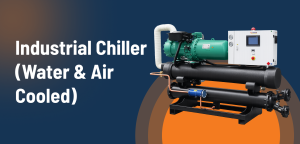
Both chiller types do the same job they remove heat from process water (or another coolant fluid) that circulates through your molding machine, extruder dies, or hydraulic systems. The difference is how the chiller itself gets rid of the heat it absorbed.
Air Cooled Chillers
Air cooled chillers use a fan (or multiple fans) to blow ambient air across a refrigerant condenser coil mounted on the chiller body. The hot refrigerant cools as the air passes over it; that air gets blown out into the atmosphere. Everything happens within the chiller unit no external cooling tower required.
Think of it like an air conditioner outdoor unit, but bigger and specifically tuned for industrial process cooling.
Water Cooled Chillers
Water cooled chillers use water (not air) to absorb heat from the refrigerant. The heated water then flows to an external cooling tower, where it loses heat by evaporation, and returns to the chiller in a closed loop. This requires a separate cooling tower installation typically on the roof or in an outdoor area.
Because water is a far better heat transfer medium than air, the cooling cycle is more efficient. The trade-off is the additional infrastructure required (cooling tower, pumps, water treatment).
Side-by-Side Comparison
| Factor | Air Cooled | Water Cooled |
|---|---|---|
| Installation cost | Lower single unit | Higher chiller + cooling tower + pumps + piping |
| Operating efficiency (COP) | 2.6 – 3.0 | 3.5 – 5.0 (15-25% better) |
| Floor space | Chiller footprint only | Chiller + cooling tower (more total space) |
| Water consumption | Zero process water | Make-up water for evaporation (typically 2-3% of circulation) |
| Performance in summer (40°C+) | Drops 15-20% ambient air is hot | Holds steady water cooling is less affected |
| Maintenance complexity | Simpler fan, coil cleaning | More water treatment, tower cleaning, scale prevention |
| Best capacity range | Up to 30 TR | 20 TR and above |
| Lifespan | 10-12 years typical | 12-15 years typical |
| Noise | Higher (fans) | Lower only pumps |
When to Choose Air Cooled
An air cooled chiller is the better choice when:
- Your cooling load is below 20-25 TR. Below this capacity, the extra cost of a cooling tower for water cooled systems isn’t justified by efficiency gains.
- Water is scarce or expensive. Cities like Chennai, Bangalore, parts of Rajasthan and Karnataka face water shortages. Water cooled systems consume 5-10% of circulation water in evaporation losses, which adds up.
- Your plant runs intermittent shifts. Single-shift operations don’t accumulate the operating hours needed to amortise the higher installation cost of water cooled systems.
- You need simple maintenance. Air cooled units have fewer moving parts and no water chemistry to monitor. Maintenance is just periodic coil cleaning and fan checks.
- You want minimum footprint. A self-contained air cooled chiller fits in places where a chiller + cooling tower combo won’t.
- Your climate is dry/temperate. Air cooled chillers perform much better in dry climates (north India winters, Pune, Bangalore) than in hot-humid coastal climates (Mumbai, Chennai, Kolkata).
When to Choose Water Cooled
Water cooled chillers make sense when:
- Your cooling load is above 30 TR. At larger capacities, the 15-25% efficiency advantage of water cooling adds up to significant lakhs in annual electricity savings.
- You run 2-3 shifts daily. Continuous operation amortises the higher capex quickly through lower opex.
- Your plant is in a hot-humid climate. Mumbai, Chennai, Kolkata, coastal areas air cooled performance drops in summer when ambient temperatures exceed 40°C and humidity is high. Water cooled chillers hold steady performance.
- You already have a cooling tower. If there’s an existing tower with spare capacity, the incremental cost of adding a water cooled chiller is much lower.
- Electricity is your biggest operating expense. Plants where electricity dominates the cost structure benefit most from water cooling’s efficiency.
- You need lower process temperatures. Water cooled systems can achieve lower chilled water set-points (down to 5-7°C) more efficiently than air cooled.
A Real-World Cost Comparison
For a 50 TR cooling load running 16 hours/day: an air cooled chiller costs roughly ₹8 lakh installed; a water cooled chiller + cooling tower costs roughly ₹11 lakh installed. But the air cooled system uses ~20% more electricity. At ₹8/kWh, that’s an additional ₹1.5 lakh per year in electricity. The water cooled system pays back its extra ₹3 lakh upfront within 2 years and saves money every year after.
The Climate Factor Indian Buyers Ignore
One of the biggest mistakes Indian buyers make is choosing a chiller based on its nameplate TR rating without considering local ambient conditions. Chillers are rated at standard conditions (usually 35°C ambient for air cooled). When ambient hits 45°C in May-June, an air cooled chiller’s effective capacity can drop by 15-20%.
What this means in practice:
- If you operate in Rajasthan, Vidarbha, or Telangana, where peak summer temperatures regularly exceed 45°C, oversize your air cooled chiller by 20-25%. Or go water cooled.
- If you operate in coastal humid areas (Mumbai, Chennai, Kolkata, Vizag), water cooled chillers usually outperform air cooled despite the same nameplate TR.
- If you operate in Pune, Bangalore, Hyderabad moderate climates air cooled chillers up to 30-40 TR work fine year-round.
Sizing Your Chiller for Plastic Processing
Sizing depends on the type of plastic processing equipment you’re cooling. Some rough rules of thumb:
| Process | Cooling Load (per unit of equipment) |
|---|---|
| Injection Molding | 1 TR per 25-30 tonnes of clamping force |
| Blow Molding | 1 TR per 30-50 kg/hr throughput |
| Extrusion (PP, PE) | 1 TR per 40-60 kg/hr throughput |
| Extrusion (PVC) | 1 TR per 25-35 kg/hr throughput |
| PET Preform | 1 TR per 15-20 kg/hr throughput |
These are starting points; the exact number depends on cycle time, mold geometry, ambient conditions, and chilled water temperature target. Always specify with your chiller manufacturer based on your actual production data.
Other Factors That Matter
Refrigerant type. Modern chillers use environmentally friendly refrigerants like R-410A, R-407C, or R-134a. Older R-22 systems are being phased out. Check what your chiller uses and confirm spare gas is easily available locally.
Compressor brand. The compressor is the heart of any chiller. Reputable brands (Copeland, Bitzer, Danfoss, Hitachi) cost more upfront but offer 10-15 year reliability. Unknown-brand compressors may save 10-15% but often need replacement in 5-7 years.
Control system. Look for a microprocessor control panel with temperature display, fault diagnostics and remote monitoring options. Cheaper analog controls work but you’ll be flying blind when something goes wrong.
Energy efficiency. Ask for the COP (Coefficient of Performance) and EER ratings. Higher numbers mean less electricity for the same cooling. For a 50 TR chiller running 16 hours daily, a COP improvement from 3.0 to 4.0 saves roughly ₹2 lakh per year.
After-sales support. Chillers need annual servicing, refrigerant top-ups, and occasional component replacements. Choose a manufacturer with service technicians available within your region a chiller down for 2 weeks because parts aren’t available is a production disaster.
Wrapping Up
The air vs water cooled decision isn’t about which is “better” in absolute terms both are excellent technologies. It’s about which fits your specific operating profile: capacity, climate, water availability, electricity cost, shift hours, and budget.
For most Indian plastic processors below 25 TR with single or double shift operations, air cooled chillers offer the simplest and most cost-effective solution. For larger plants running continuous shifts in humid coastal climates, water cooled chillers pay back their higher upfront cost in 2-3 years through lower electricity bills.
At Seaways Machinery, we manufacture both air-cooled and water-cooled industrial chillers from 1 TR to 100 TR at our Rajkot facility. If you’d like a sizing analysis specific to your plant, send us your equipment list and operating hours, and we’ll send a custom proposal within 24 hours.
You May Also Like: