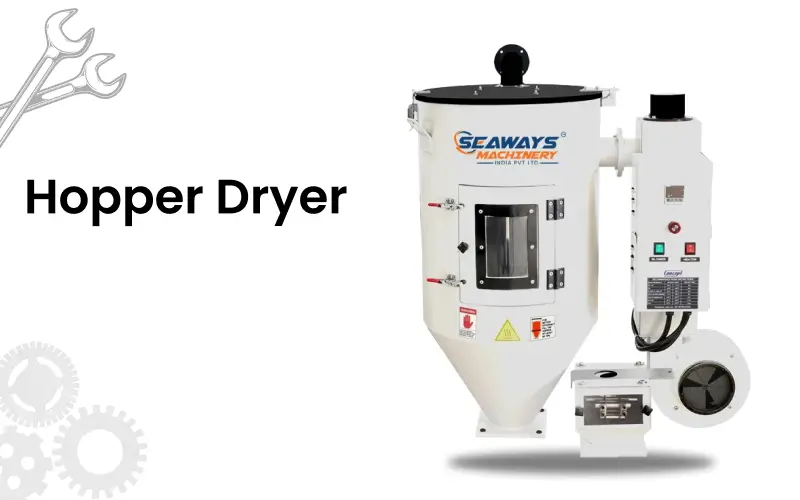
Most plastic processors know they need to dry their granules before processing. What’s less commonly understood is exactly how the hopper dryer pulls moisture out and why every parameter (temperature, time, air flow, dew point) matters for the final part quality.
This guide walks through the working principle, the major components, the difference between hygroscopic and non-hygroscopic plastics, drying temperature requirements for common materials, and how to size a hopper dryer for your production line.
TLDR In One Paragraph
A hopper dryer circulates hot, dry air through plastic granules sitting in an insulated hopper. Heat transfers from the air to the granules, driving moisture from inside the granule to its surface and into the air stream. The moisture-laden air exits, gets dried (via desiccant in advanced dryers) and reheated, then recirculates. The granules emerge at the target moisture level typically 0.02-0.05% for engineering plastics ready for injection, extrusion or blow molding.
Why Plastic Granules Need Drying in the First Place
Plastics absorb moisture from the air at different rates. Some plastics barely absorb any (called non-hygroscopic PP, PE, PS). Others are hungry for water (called hygroscopic PET, nylon, PC, PBT, ABS, acrylic). At humid Indian conditions, hygroscopic granules can reach 0.2-0.5% moisture content in a few hours of exposure to ambient air.
Half a percent doesn’t sound like much. But when those wet granules hit a barrel at 260-300°C, the moisture flashes to steam at extreme volume water expands roughly 1700 times when it boils. That steam:
- Creates surface defects on parts (splay marks, silver streaks)
- Causes voids and weak weld lines inside the part
- Hydrolyses the polymer chains, breaking them down and reducing mechanical strength permanently
- Causes process instability and inconsistent shot weights
For PET preform manufacturing, processing wet PET is the difference between a clear, strong preform and a hazy, brittle one. For nylon engineering components, wet processing means broken parts under load. The hopper dryer is the equipment that prevents all of this.
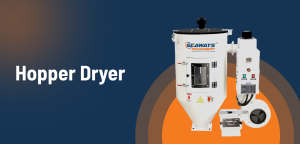
The Major Components of a Hopper Dryer
A standard industrial hopper dryer has these core parts:
1. Insulated Hopper
The hopper itself is a stainless steel cone or rectangular bin that holds the granules being dried. Quality dryers use double-wall construction with insulation (usually rockwool or polyurethane foam, 50-100 mm thick) between the inner and outer walls. Insulation matters because heat loss through hopper walls wastes energy and creates temperature gradients within the granule bed.
2. Heater Bank
Electric heaters (typically stainless steel tubular elements) heat the air to the required drying temperature. Heater capacity is sized based on the drying temperature target and air flow rate anywhere from 6 kW for small 50 kg dryers to 60+ kW for large 1000 kg industrial dryers.
3. Blower / Fan
A regenerative or centrifugal blower forces hot air through the granule bed. Air flow rate is specified in CFM (cubic feet per minute) or m³/hr and is critical too low and drying is uneven, too high and you waste energy heating excess air.
4. Air Distribution Plate
At the base of the hopper, a perforated steel plate distributes hot air evenly across the entire granule bed. Without this, air takes the path of least resistance, creating dry spots and wet spots in the same hopper.
5. Filter
An air filter prevents plastic dust and fines from entering the blower or heater. Standard filters are cleanable or replaceable depending on dryer size and operating environment.
6. Temperature Controller
A PID temperature controller monitors air temperature via thermocouples and modulates the heater output. Quality dryers include both air-inlet and air-return temperature sensors so you can confirm proper drying.
7. Desiccant System (advanced dryers only)
For drying highly hygroscopic plastics (PET, PA, PC) to very low moisture levels, hot air alone isn’t enough the return air is already partially saturated. Desiccant dryers add molecular-sieve drying wheels or beds that reduce return-air dew point to -40°C or lower, enabling deeper drying. Standard hopper dryers without desiccants typically achieve dew points of +10 to +20°C, which is fine for most non-hygroscopic and lightly-hygroscopic plastics.
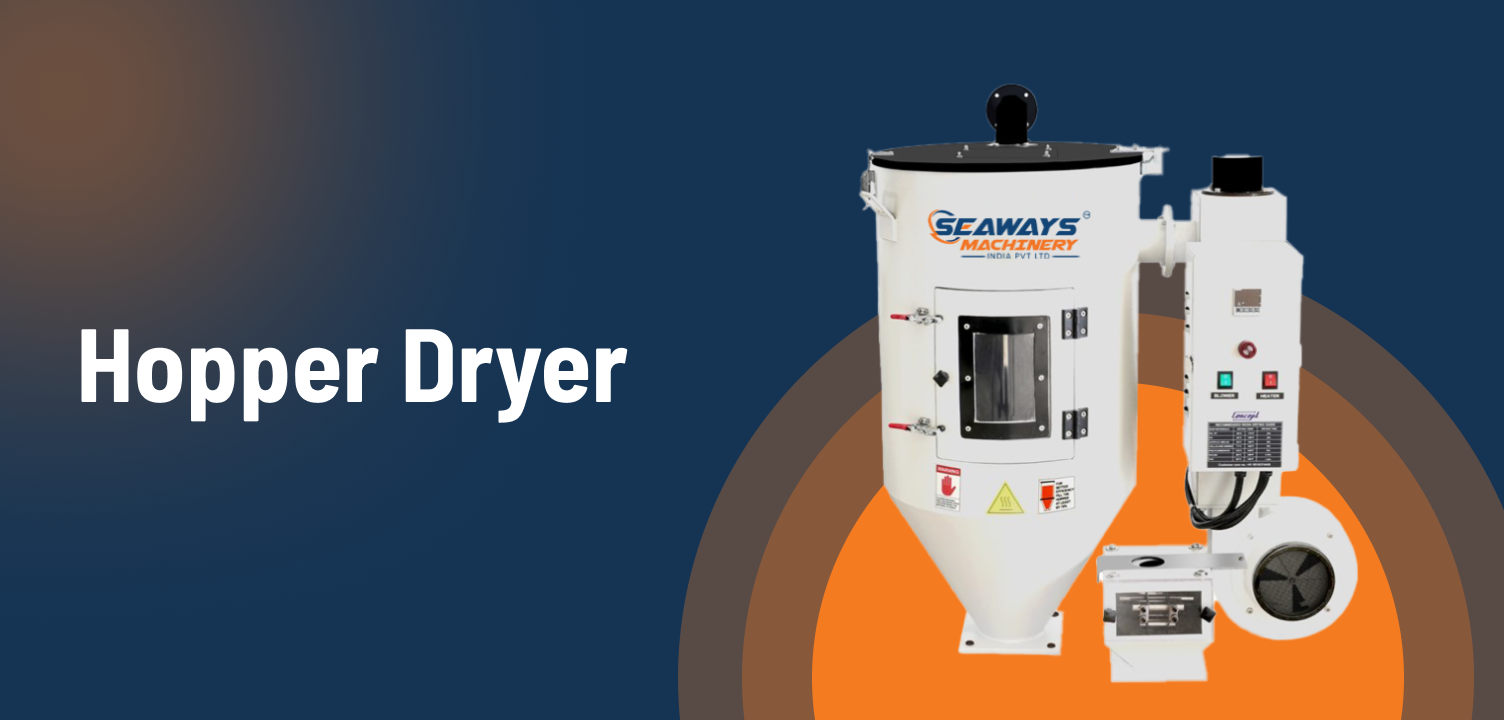
The Working Principle: How Moisture Actually Leaves the Granule
Here’s what happens inside the hopper, step by step:
Step 1 Heating. The blower draws air through the heater bank, raising it to the drying set-point temperature (e.g. 160°C for PET). This hot air also has low absolute humidity because heating it expands its moisture capacity dramatically.
Step 2 Distribution. The hot dry air enters the bottom of the hopper through the perforated air-distribution plate. It rises through the entire bed of granules sitting in the hopper, contacting every granule on its way up.
Step 3 Heat transfer to granules. As hot air contacts the cooler granules, heat transfers from air to plastic. The granule surface temperature rises rapidly; heat then conducts inward toward the granule core. After 30-60 minutes (depending on granule size), the entire granule reaches the drying temperature throughout.
Step 4 Moisture migration. As granules heat up, water molecules trapped inside become mobile. They diffuse outward from high-concentration zones (granule core) toward low-concentration zones (granule surface, then the dry air around it). This diffusion is what takes time. Drying time isn’t really about heating; it’s about giving moisture enough time to migrate from inside the granule to the surface.
Step 5 Evaporation. When moisture reaches the granule surface, the dry hot air evaporates it instantly. The moisture is now water vapour in the air stream.
Step 6 Moisture removal. The now moisture-laden air exits the top of the hopper. In a simple recirculation dryer, it gets reheated and returned (which works fine for non-hygroscopic plastics). In a desiccant dryer, the air passes through a desiccant wheel that captures moisture, dropping the dew point dramatically before reheating and return.
Step 7 Continuous cycle. This loop runs continuously. Wet incoming granules from your storage silo enter the hopper top; dried granules exit the hopper bottom into your processing machine (extruder, injection molder, etc.) at the rate of consumption.
Why Drying Time Cannot Be Shortcut
Moisture diffusion inside a plastic granule follows Fick’s law of diffusion the rate is fundamentally limited by polymer molecular structure and granule diameter. You cannot dry a 3 mm PET granule from 0.3% to 0.02% moisture in 30 minutes regardless of how hot you make the air. Required drying time is roughly 4 hours for PET, 4-6 hours for nylon, 3-4 hours for PC. Trying to shortcut this leads to incomplete drying moisture remains in the granule core even though the surface is dry.
Hygroscopic vs Non-Hygroscopic Plastics
The distinction matters because it determines what kind of dryer you need.
Non-Hygroscopic Plastics
PP, PE, PS, PVC absorb very little moisture from the air. They typically don’t need drying at all in normal conditions and if they do (e.g. after rain exposure or recycled material), a simple hot-air hopper dryer without desiccant works fine. Drying is at 80-100°C for 1-2 hours and removes surface moisture rather than internal moisture.
Hygroscopic Plastics
PET, nylon (PA6, PA66, PA12), polycarbonate (PC), PBT, ABS, acrylic (PMMA), TPU absorb significant moisture into their internal structure. They need:
- Higher drying temperatures (typically 80-180°C depending on material)
- Longer drying times (3-6 hours minimum)
- Lower dew point (desiccant drying for highly hygroscopic materials like PET and PA)
Drying Temperatures and Times for Common Plastics
Always confirm exact parameters with your material supplier’s data sheet. These are typical starting points:
| Material | Drying Temperature | Drying Time | Target Moisture | Desiccant Needed? |
|---|---|---|---|---|
| PET (preform, bottle) | 160-180°C | 4-6 hours | <0.005% | Yes strongly recommended |
| Nylon (PA6, PA66) | 80-100°C | 4-6 hours | <0.1% | Yes for critical parts |
| Polycarbonate (PC) | 120°C | 3-4 hours | <0.02% | Recommended |
| ABS | 80°C | 2-4 hours | <0.1% | Optional |
| PBT | 120°C | 3-4 hours | <0.04% | Recommended |
| PMMA (Acrylic) | 80°C | 2-4 hours | <0.04% | Optional |
| TPU | 80-100°C | 2-3 hours | <0.05% | Recommended |
| PP / PE (if needed) | 80-90°C | 1-2 hours | <0.1% | Not needed |
Note: over-drying is also a problem. PA66 dried excessively becomes brittle. PC over-dried for too long discolours. Set times based on your actual residence time in the hopper, not safety margins that lead to material degradation.
How to Size a Hopper Dryer for Your Production Line
Hopper dryer sizing follows a simple formula:
Hopper capacity = (Hourly throughput) × (Required drying time) × Safety factor (1.2-1.3)
For example, if you’re processing 50 kg/hr of PET (4-hour drying time):
Hopper capacity = 50 × 4 × 1.2 = 240 kg minimum.
Round up to a standard 250 kg or 300 kg hopper dryer. The safety factor accounts for production variations, brief throughput spikes, and the practical need to have some buffer in the hopper.
| Hourly Throughput | PET (4hr) | Nylon (5hr) | PC (3.5hr) | ABS (3hr) |
|---|---|---|---|---|
| 25 kg/hr | 120 kg | 150 kg | 105 kg | 90 kg |
| 50 kg/hr | 240 kg | 300 kg | 210 kg | 180 kg |
| 100 kg/hr | 480 kg | 600 kg | 420 kg | 360 kg |
| 200 kg/hr | 960 kg | 1200 kg | 840 kg | 720 kg |
Energy Efficiency: Where Hopper Dryers Differ Most
Drying is energy-intensive. A 500 kg PET dryer can consume 20-25 kW of electricity continuously that’s a major opex line item. Three things differentiate energy-efficient hopper dryers from cheap ones:
1. Insulation quality. Properly insulated hoppers lose 30-40% less heat than cheap single-wall designs. Look for 60-100 mm rockwool or polyurethane insulation, with double-wall stainless steel construction.
2. Heat recovery. Advanced dryers route the exit air through a heat exchanger that pre-heats incoming air, recovering significant energy. Standard recirculation already preserves heat in the loop; heat recovery on the exhaust improves further.
3. Smart controls. PLC controls that modulate heater power based on actual air temperature (rather than simple on/off cycling) reduce energy waste. Some advanced units shut down circulation during low-throughput periods.
For continuous-operation plastic processors, choosing an energy-efficient hopper dryer over a basic one typically pays back the cost difference in 18-24 months through lower electricity bills.
Maintenance Essentials
A hopper dryer is mechanically simple but requires regular attention:
- Weekly: Check air filter for dust and clean or replace as needed. Verify temperature display matches set point.
- Monthly: Inspect heater elements for proper function. Clean the air distribution plate of any plastic dust accumulation.
- Quarterly: Check blower motor bearings and lubricate as needed. Verify thermocouple calibration.
- Annually: Complete inspection of insulation integrity, heater bank, electrical connections. Replace any worn gaskets or seals.
- For desiccant dryers: Replace or regenerate desiccant bed per manufacturer schedule (typically every 6-12 months depending on usage).
Wrapping Up
The hopper dryer is one of those pieces of equipment where attention to detail separates “good enough” from “excellent.” A dryer that doesn’t reach the right temperature, doesn’t hold it consistently, or doesn’t run long enough produces parts that look fine externally but have hidden quality problems.
For Indian plastic processors especially those running PET preform lines, pharma packaging, engineering components, or any hygroscopic material investing in a properly-sized, well-insulated, properly-instrumented hopper dryer pays back through consistent part quality, lower scrap rates, and stable processing.
At Seaways Machinery, we manufacture hopper dryers from 25 kg to 1000+ kg capacity at our Rajkot facility, with both standard hot-air and desiccant-dryer variants. If you’d like sizing help for your specific material and throughput, send us your details and we’ll send a custom recommendation within 24 hours.