If you run a plastic recycling unit, packaging line, or any plastic processing setup in India, you’ve probably worked with a scrap grinder — or you’re thinking about buying one. But how does the machine actually turn a pile of plastic waste into uniform granules ready for re-extrusion? Let’s break it down.
This guide covers the working principle, the major components, the three main types of grinders, what materials they handle, and how to choose the right capacity for your unit. It’s written for plant managers, procurement leads and entrepreneurs setting up new plastic recycling operations.
TL;DR — In One Paragraph
A plastic scrap grinder cuts plastic waste between a fast-rotating set of blades (rotor) and fixed blades (stator) inside a cutting chamber. The cut material falls through a perforated screen that controls particle size. A motor (usually 5-100 HP) drives the rotor; capacity ranges from 50 kg/hr in small units to 1000+ kg/hr in industrial models. Choice depends on what plastic you process, how much per hour, and how clean the input is.
The Six Core Components of a Plastic Grinder
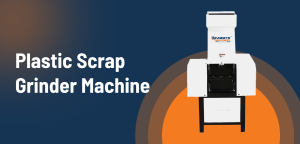
Every grinder, whether it’s a 5 HP unit at a small recycling shop or a 100 HP industrial machine, has the same six fundamental components. Understanding these helps you specify, operate, and maintain the machine.
1. Feed Hopper
The hopper is the entry point — usually a steel-walled cone or rectangular bin at the top of the machine. Larger hoppers can accept full bags of scrap; smaller ones require operators to feed material in batches. Some industrial hoppers include a conveyor belt or auto-feeder to maintain continuous input.
2. Cutting Chamber (Cutter Box)
This is where the actual grinding happens. The cutting chamber is a heavy steel enclosure that houses the rotor and stator blades. Industrial grinders use hardened tool steel (D2, SKD-11 or similar) for the chamber walls because the material constantly impacts them. The chamber is typically hinged or boltable open for blade access during maintenance.
3. Rotor (Rotating Blades)
The rotor is a horizontally-mounted cylinder with cutting blades bolted along its length, rotating at 200 to 900 RPM depending on the grinder type. Rotor blades come in different configurations — straight blades for hard plastics like PVC and ABS, V-shaped blades for film and fibre, and claw or stepped blades for bulky items like crates or pipes.
4. Stator (Fixed Blades)
Mounted on the cutting chamber wall opposite the rotor, the stator (or bed knife) provides the fixed cutting edge. Plastic gets pinched between rotor and stator blades — that’s where the actual cutting happens. The gap between rotor and stator (called the cutting gap) is critical; too wide and material doesn’t cut cleanly, too narrow and blades wear quickly. Standard cutting gaps are 0.2 to 0.5 mm.
5. Perforated Screen (Sieve)
Below the cutting chamber sits a curved perforated metal screen. Plastic only exits when it’s cut small enough to pass through the holes. Standard screen hole sizes range from 6 mm to 16 mm. Smaller holes give finer regrind but reduce throughput; larger holes increase throughput but produce coarser output. Most recyclers use 10-12 mm screens for general work.
6. Drive Motor & Belt System
An electric motor (typically 5 HP for small grinders, up to 100 HP for industrial) drives the rotor through a V-belt and pulley system. Belt drive isolates motor vibration from the cutting chamber and acts as a slip-clutch if jamming occurs. Direct-drive grinders exist but are less common in India due to repair complexity.
The Working Principle: Step-by-Step
Here’s exactly what happens when plastic waste enters a scrap grinder:
Step 1 — Feeding. Plastic scrap (bottles, films, sprues, runners, defective parts) is dropped into the feed hopper. Operators may pre-sort by colour and material type, since mixed plastics produce lower-quality regrind.
Step 2 — Gravity and rotor pull. Material falls toward the cutting chamber. The fast-rotating rotor creates a suction effect that pulls material deeper into the cutting zone. This is why hopper design matters — narrow hoppers feed faster; wide hoppers can bridge or clog.
Step 3 — Cutting action. As plastic enters the rotor’s swing path, it gets caught between rotor blades (rotating at high speed) and stator blades (fixed). Each pass between the two cutting edges produces a clean shearing cut. With multiple rotor blades, each piece of plastic gets cut many times per second.
Step 4 — Size reduction by screen. Cut fragments swirl inside the chamber as the rotor keeps turning. Pieces small enough to fit through the perforated screen drop through immediately. Larger pieces stay in the chamber for further cutting until they reach the right size.
Step 5 — Collection. Regrind exits below the screen into a collection bin, conveyor belt, or pneumatic suction system that transports it to storage silos or directly to the next process (extrusion, washing, etc.).
Why Cutting Gap Matters
If the cutting gap between rotor and stator drifts beyond 0.5 mm (due to blade wear), you’ll see uncut strands in your regrind, more heat generation, and motor overload. This is the single most common cause of grinder underperformance — and the easiest to fix. Inspect and adjust blade gap every 150-200 operating hours.
The Three Types: Low, Medium and High Speed Grinders
Grinders are categorised primarily by rotor speed, which determines what materials they handle best.
| Type | Rotor Speed | Best For | Drawbacks |
|---|---|---|---|
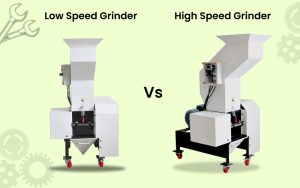
| Low Speed (Beside-the-Press) | 20-100 RPM | Clean sprues, runners, rejects directly at the molding machine — low noise, low dust | Lower throughput, not for bulk recycling |
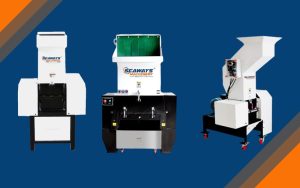
| Medium Speed | 200-400 RPM | General purpose recycling — bottles, containers, sheet, film at moderate volume | Compromise between throughput and quality |
| High Speed (Industrial) | 400-900 RPM | Heavy-duty recycling — tough materials, high throughput, continuous operation | More heat, more dust/fines, louder operation |
For most Indian plastic recyclers operating in places like Vatva, Bhiwandi or Faridabad, a medium or high-speed grinder is the workhorse. Beside-the-press grinders are common in injection molding setups that want to recycle defective parts immediately back into the same machine.
What Plastic Materials Can a Grinder Process?
Modern industrial plastic scrap grinders handle virtually all thermoplastics:
- PE and PP — polyethylene, polypropylene films, containers, caps. The bread-and-butter of Indian recycling.
- PET — bottles, preforms, sheet. PET is harder than PE/PP and wears blades faster.
- PVC — pipes, profiles, sheet. Hardest of the common plastics; needs robust blades and steel-clad chambers.
- HDPE / LDPE — milk crates, bottles, films. Soft materials need V-cut blades to prevent material wrapping.
- ABS, PC, PS, Nylon — engineering plastics from auto components, electrical fittings, packaging. Generally hard, brittle — easy to cut.
What doesn’t work well: thermosets (Bakelite, melamine), rubber, heavily contaminated metallised films, materials with embedded metal. These either jam the grinder or damage blades.
Capacity Ranges: How Much Throughput Do You Need?
Throughput depends on motor power, rotor diameter, screen size and material type. Here’s a rough guide:
| Motor HP | Capacity (kg/hr) | Typical Application |
|---|---|---|
| 5 HP | 50-100 kg/hr | Small recycling shops, beside-the-press use |
| 10 HP | 100-200 kg/hr | Mid-size recyclers, packaging units |
| 20-30 HP | 250-500 kg/hr | Mid-to-large recyclers, multi-shift operations |
| 50 HP | 500-800 kg/hr | Large recycling plants, continuous duty |
| 75-100 HP | 800-1500+ kg/hr | Heavy industrial recycling, washing line input |
A good rule of thumb: pick a grinder with 25-30% more capacity than your current daily throughput requirement. This buffer lets you handle peak volumes, run shorter shifts, and prevents the grinder from being your production bottleneck.
5 Things to Check Before Buying a Plastic Scrap Grinder
1. Blade material and hardness. Look for D2, SKD-11 or equivalent tool steel, heat-treated to 58-62 HRC. Soft blades wear out in months; hardened blades last years. Ask the manufacturer about blade life expectancy in your material.
2. Cutting chamber wall thickness. Industrial-grade chambers use 25-30 mm walls. Cheap units cut corners here with 15-18 mm walls that flex during heavy duty and accelerate blade wear.
3. Sound enclosure. Plastic grinders are loud — 90-100 dB without sound dampening. A proper acoustic enclosure brings noise down to 75-80 dB. Worth the small premium for operator safety and compliance.
4. Easy access for blade changes. You’ll be changing blades multiple times a year. Look for chambers with hydraulic-tilt or hinged opening, not bolts you need to undo for an hour. Time spent maintaining = money lost.
5. After-sales service network. Critical spares — blades, screens, bearings, belts — should reach you within 24-48 hours when you need them. A grinder that’s down for 2 weeks waiting for a part is no cheaper than a premium one that runs.
Common Mistake
The most common mistake we see Indian plastic recyclers make is buying a grinder one size smaller than they actually need, hoping to save 15-20% on capital cost. Within 12 months, the smaller grinder becomes a production bottleneck and they end up buying a second one anyway — at higher total cost than just buying the right size upfront.
Wrapping Up
A plastic scrap grinder is mechanically simple — rotor, stator, screen, motor — but the details (blade material, cutting gap, chamber design, service support) make the difference between a machine that runs reliably for a decade and one that becomes a constant headache.
If you’re planning to set up or scale a plastic recycling unit anywhere in India, work backwards from your daily throughput target, choose a model with 25-30% buffer capacity, prioritise blade material and after-sales support, and visit the manufacturer’s factory before deciding. The right grinder pays for itself within 12-18 months in clean regrind that sells at higher prices.
At Seaways Machinery, we manufacture plastic scrap grinders from 5 HP to 100 HP at our Rajkot facility, with hardened tool-steel blades, robust chamber design and on-site installation across India. If you’d like to talk through what configuration fits your unit, get in touch — we’ll send a technical proposal within 24 hours.