Quick Answer – Mould Temperature Controllers in One Paragraph
A mould temperature controller (MTC) circulates heated or cooled fluid (water or thermal oil) through channels inside an injection mould to keep the mould at a precise temperature throughout the production cycle. Water-type MTCs handle 40-95°C standard or up to 180°C in pressurised versions; oil-type MTCs handle 60-350°C for high-temperature engineering plastics, die casting and rubber. Proper mould temperature control is essential for dimensional accuracy, surface finish, mechanical strength and cycle time optimisation. In India, MTCs cost ₹45,000 (small water-type) to ₹4 lakh+ (high-capacity oil-type) depending on capacity, temperature range and features.
What is a Mould Temperature Controller?
A mould temperature controller often abbreviated as MTC or sometimes called a “mould temperature control unit” (MTCU) is auxiliary equipment used alongside injection moulding machines, blow moulders, die casters and rubber presses to maintain the temperature of a production mould at a precise set point throughout every production cycle.
The mould (also called the tool or die) in plastic injection moulding has cooling channels machined into both halves. An MTC circulates a heat-transfer fluid through these channels to either remove heat from the mould (when the mould is too hot from injection) or add heat to the mould (when it’s too cool for optimal moulding). Modern MTCs use PID-based control loops with thermocouple feedback to maintain mould temperature within ±0.5 to ±1°C of the set point.
While the basic concept sounds simple, the impact on production is significant. Mould temperature directly affects polymer flow inside the cavity, the rate of cooling and crystallisation, the level of residual stress in the finished part, dimensional accuracy, surface finish, and the time required for each cycle. A well-controlled mould temperature is the difference between consistent high-quality production and an endless stream of rejects.
Why Mould Temperature Matters: The Effect on Part Quality
Most injection moulders learn this the hard way: when something goes wrong with part quality, the mould temperature is usually involved. Here are the specific quality issues that improper mould temperature creates:
Issues When Mould is Too Cold
- Short shots – molten plastic freezes before completely filling the cavity
- Poor surface finish – visible flow lines, dull or rough surfaces
- Weld line weakness – incomplete fusion at points where flow fronts meet
- High residual stress – internal tension that causes warping or stress cracking
- Poor crystallinity in semi-crystalline plastics (PP, PE, PA) – reduced mechanical strength
- Sink marks – surface depressions over thick sections
Issues When Mould is Too Hot
- Flash – excess plastic forced into parting lines
- Long cycle times – extended cooling phases reduce throughput
- Part distortion from premature ejection while still soft
- Hydrolytic degradation in hygroscopic plastics if temperature exceeds the safe processing range
- Excessive shrinkage leading to dimensional errors
- Mould fouling from sticking and surface chemistry changes
Issues from Inconsistent Mould Temperature
Even more damaging than too hot or too cold is inconsistent mould temperature. If your mould temperature varies by ±5°C from shot to shot, you’ll see:
- Dimensional variation parts measuring differently across the production run
- Inconsistent shrinkage affecting assembly fit
- Variable mechanical properties some parts pass strength tests, others fail
- Yield variation wider distribution of conforming vs reject parts
This is exactly the problem a properly-sized, properly-maintained mould temperature controller solves. By holding the mould within ±0.5-1°C cycle after cycle, the MTC removes mould temperature from your list of process variables letting you focus on the other parameters that affect quality.
How Does a Mould Temperature Controller Work?
The working principle of an MTC is straightforward but the engineering execution is what separates good MTCs from poor ones. Here’s the step-by-step operation:
Step 1 – Fluid reservoir and circulation. The MTC holds a tank of heat-transfer fluid (water or thermal oil). A circulation pump moves this fluid in a closed loop through the MTC’s heating chamber and cooling exchanger, then out to the mould’s cooling channels and back.
Step 2 – Heating. Electric immersion heaters (typically stainless steel or copper sheathed) heat the fluid to the set point. Heating power varies by MTC capacity typically 6 kW for small units, 9-24 kW for medium-to-large, and 36+ kW for industrial-scale.
Step 3 – Cooling. When the mould returns hotter fluid than the set point (which happens during the injection-pack-hold phases when molten plastic dumps heat into the mould), the cooling solenoid valve opens and cold water from an external chiller or cooling tower flows through the MTC’s heat exchanger. This cools the recirculating fluid back to set point.
Step 4 – Temperature feedback. Thermocouples on both the supply line (going to mould) and return line (coming from mould) feed temperature data to the PID controller. The controller modulates heater output and cooling valve opening 10-100 times per second to maintain stable temperature.
Step 5 – Mould heat exchange. Inside the mould, the circulating fluid runs through machined channels close to the mould cavity surface. Heat moves from the mould steel to the fluid (cooling the mould) or from the fluid to the steel (heating the mould) by simple conduction.
Step 6 – Continuous loop. This entire cycle runs continuously, hundreds of times per second. The result: mould temperature held within ±0.5-1°C of set point throughout your entire production run, despite the constant heat flux from each shot of molten plastic.
Why PID Control Matters
The PID (Proportional-Integral-Derivative) controller is the brain of any quality MTC. Cheap MTCs use simple on-off control heat on until target reached, heat off until temperature drops, repeat. This produces large oscillations (±3-5°C). Quality MTCs with proper PID control modulate heating power continuously based on three parameters: how far from set point (P), how long off set point (I), and how fast changing (D). The result is rock-steady temperature with tiny oscillations. When evaluating MTCs, always ask about the control algorithm PID is non-negotiable for serious moulding.
Types of Mould Temperature Controllers
MTCs are classified primarily by the heat-transfer fluid they use. The three main types in commercial use:
1. Water-Type MTC (Standard)
Uses ordinary water (treated to prevent scaling) as the heat-transfer fluid. Operates up to 90-95°C at atmospheric pressure limited by water’s boiling point. This is the most common MTC type, suitable for the vast majority of standard injection moulding applications (PP, PE, PS, ABS, PVC at typical processing temperatures).
- Temperature range: Ambient to 90-95°C
- Best for: Standard injection moulding, packaging, household plastics, PVC processing
- Advantages: Lowest cost, simplest design, easy maintenance, water is a free and effective coolant
- Limitations: Cannot exceed 95°C without pressurisation; scaling issues if water quality is poor
2. Pressurised Water-Type MTC (High Temperature)
Same architecture as standard water-type, but the fluid loop is sealed and pressurised typically 3-6 bar. This raises water’s effective boiling point, allowing operation up to 120°C (3 bar systems) or 160-180°C (6 bar systems). Used when applications need higher mould temperatures than standard water can deliver, but oil-type complexity isn’t justified.
- Temperature range: Ambient to 120-180°C depending on pressure rating
- Best for: Engineering plastics (ABS, PC, PA at higher end), automotive components, electronics housings
- Advantages: Higher temperature than standard water; still uses water (cheap, clean, safe); good thermal efficiency
- Limitations: Pressurised system requires safety controls; higher cost than standard water-type; needs careful water quality management
3. Oil-Type MTC (Very High Temperature)
Uses thermal oil (typically silicone or synthetic heat-transfer oils rated for 350°C+ continuous duty) as the heat-transfer fluid. Operates up to 300-350°C depending on oil specification and system design. Required for processing high-temperature engineering plastics (PEEK, PPS, PEI), PET preform/sheet at high temperatures, die casting, and rubber moulding.
- Temperature range: Ambient to 300-350°C
- Best for: PEEK, PPS, PEI, PC at high end, PET sheet/preform, die casting, rubber compression and injection moulding
- Advantages: Very high temperature capability; suitable for thermoset and high-performance polymers
- Limitations: Higher capital and operating cost; thermal oil requires periodic replacement; safety considerations for high-temperature operation; oil leaks more hazardous than water
Water vs Oil Mould Temperature Controllers — Side-by-Side Comparison
For most buyers, the choice between water-type and oil-type comes down to maximum temperature requirement. Here’s the practical comparison:
| Parameter | Water Type (Standard) | Water Type (Pressurised) | Oil Type |
|---|---|---|---|
| Max Temperature | 90-95°C | 120-180°C | 300-350°C |
| Heat Transfer Fluid | Treated water | Pressurised water | Thermal oil |
| System Pressure | Atmospheric | 3-6 bar | Atmospheric to 2 bar |
| Cost (Relative) | Lowest | +30-50% | +50-80% |
| Heating Speed | Fast | Fast | Slower (oil has lower specific heat) |
| Cooling Speed | Very fast | Very fast | Slower |
| Fluid Cost | Negligible | Low | ₹200-500/L for thermal oil |
| Best Applications | Standard injection moulding | Engineering plastics, automotive | PEEK, die casting, rubber |
| Maintenance | Easy | Moderate | More demanding |
| Safety Considerations | Low risk | Pressure system | Hot oil burns, fire risk if leaked |
Key Components of a Mould Temperature Controller
Understanding the core components helps when evaluating different MTC models or troubleshooting issues:
1. Tank/Reservoir: Holds the heat-transfer fluid. Made from stainless steel (water-type) or special steel rated for thermal oil (oil-type). Insulated to reduce heat loss.
2. Circulation Pump: A centrifugal pump (typically 0.75-3 HP) drives the fluid through the mould loop. Pump capacity must match heating power and target flow rate. Magnetic-drive pumps in quality units eliminate shaft-seal leakage risks.
3. Heating Element: Stainless steel or copper-sheathed immersion heaters (6-36 kW depending on MTC size). Heater material affects scaling resistance and service life.
4. Cooling Heat Exchanger: Plate or tube heat exchanger where chilled water (from your external chiller or cooling tower) removes heat from the recirculating fluid when needed.
5. Solenoid Valves: Electrically controlled valves that open and close the cooling water flow. Quality of solenoid valve directly affects temperature control precision.
6. PID Controller: Microprocessor-based controller running the PID algorithm. Quality MTCs include digital displays, multi-stage temperature programming, and overtemperature safety cutoffs.
7. Thermocouples: Temperature sensors on supply and return lines. Type-K thermocouples are standard, with accuracy of ±0.5°C typical for industrial applications.
8. Safety Devices: High-temperature cutoff, low-level fluid sensor, pressure relief valve (on pressurised systems), motor overload protection.
Recommended Mould Temperatures for Common Plastics
Always check your specific material grade’s processing data sheet these ranges can vary based on grade, additives and end-use requirements. Use this as a starting reference:
| Plastic | Mould Temperature | MTC Type Required |
|---|---|---|
| PE (Polyethylene) | 30-60°C | Water (standard) |
| PP (Polypropylene) | 40-60°C | Water (standard) |
| PS (Polystyrene) | 40-60°C | Water (standard) |
| PVC (Rigid) | 40-60°C | Water (standard) |
| ABS | 60-80°C | Water (standard) |
| SAN | 50-80°C | Water (standard) |
| PMMA (Acrylic) | 70-90°C | Water (standard) |
| PA6 (Nylon 6) | 60-90°C | Water (standard) |
| PA66 (Nylon 66) | 80-110°C | Pressurised water |
| POM (Acetal) | 80-100°C | Pressurised water |
| PBT | 80-100°C | Pressurised water |
| PC (Polycarbonate) | 80-120°C | Pressurised water |
| PET (Sheet/film) | 80-150°C | Pressurised water / Oil |
| PPS | 120-180°C | Pressurised water / Oil |
| PEEK | 160-200°C | Oil |
| TPU (Thermoplastic PU) | 25-40°C | Water (standard) |
| Silicone (LSR) | 150-200°C | Oil |
How to Choose the Right Mould Temperature Controller
Selecting the right MTC for your operation comes down to four practical decisions:
1. Choose Water-Type vs Oil-Type
Look up your material’s recommended mould temperature in the table above. If it’s ≤90°C, standard water-type MTC works. If 90-180°C, pressurised water-type MTC. If above 180°C, you need oil-type. There’s no point paying for oil-type capability you don’t need but there’s also no point under-sizing if your application demands higher temperatures.
2. Determine Heating Capacity Needed
Heating capacity (kW) depends on mould size, target temperature, and heat-up time tolerance. Approximate sizing:
- Small moulds (10-50 ton injection machine): 6 kW MTC sufficient
- Medium moulds (50-150 ton): 6-9 kW MTC
- Standard moulds (150-300 ton): 9-12 kW MTC
- Large moulds (300-500 ton): 12-18 kW MTC
- Heavy moulds (500-1000 ton): 18-24 kW MTC
- Industrial moulding (1000+ ton): 24-36+ kW MTC
3. Verify Pump Capacity
The pump must move enough fluid through the mould to maintain effective heat transfer. Generally, pump capacity (HP) scales with heating capacity: 0.75 HP for 6 kW units, 1.5 HP for 9-12 kW, 2 HP for 18-24 kW, 3 HP for 36 kW+. Higher flow rates produce more even mould temperature distribution but consume more electricity.
4. Match Cooling Source
Even when heating, your MTC needs a cooling water source for those phases when the mould runs hotter than set point. This cooling source is typically your industrial chiller (providing 7-15°C chilled water) or cooling tower water. Verify the cooling water flow rate available matches the MTC requirement specified in the manufacturer datasheet.
Industries and Applications
MTCs are used wherever moulding processes need precise temperature control:
- Plastic Injection Moulding – the largest application; nearly every quality injection moulder uses MTCs
- Blow Moulding – for bottle, container and drum production; precise neck and base temperatures critical
- PET Preform Moulding – both for cool base mould and warm neck-finish areas
- Die Casting – aluminium, zinc and magnesium casting requires high-temperature oil MTCs
- Rubber and Silicone Moulding – high-temperature compression and injection rubber moulding
- Thermoset Moulding – phenolic, melamine, epoxy moulding requires precise cure temperatures
- Composite Moulding – SMC, BMC, RTM processes
- Tyre Moulding – vulcanisation temperature control
- Optical Component Moulding – lenses, light pipes where dimensional precision is critical
- Medical Device Moulding – strict process control requirements
MTC vs Chiller – Understanding the Difference
This is one of the most common points of confusion in plastic processing equipment. The two pieces of equipment work together but do different things:
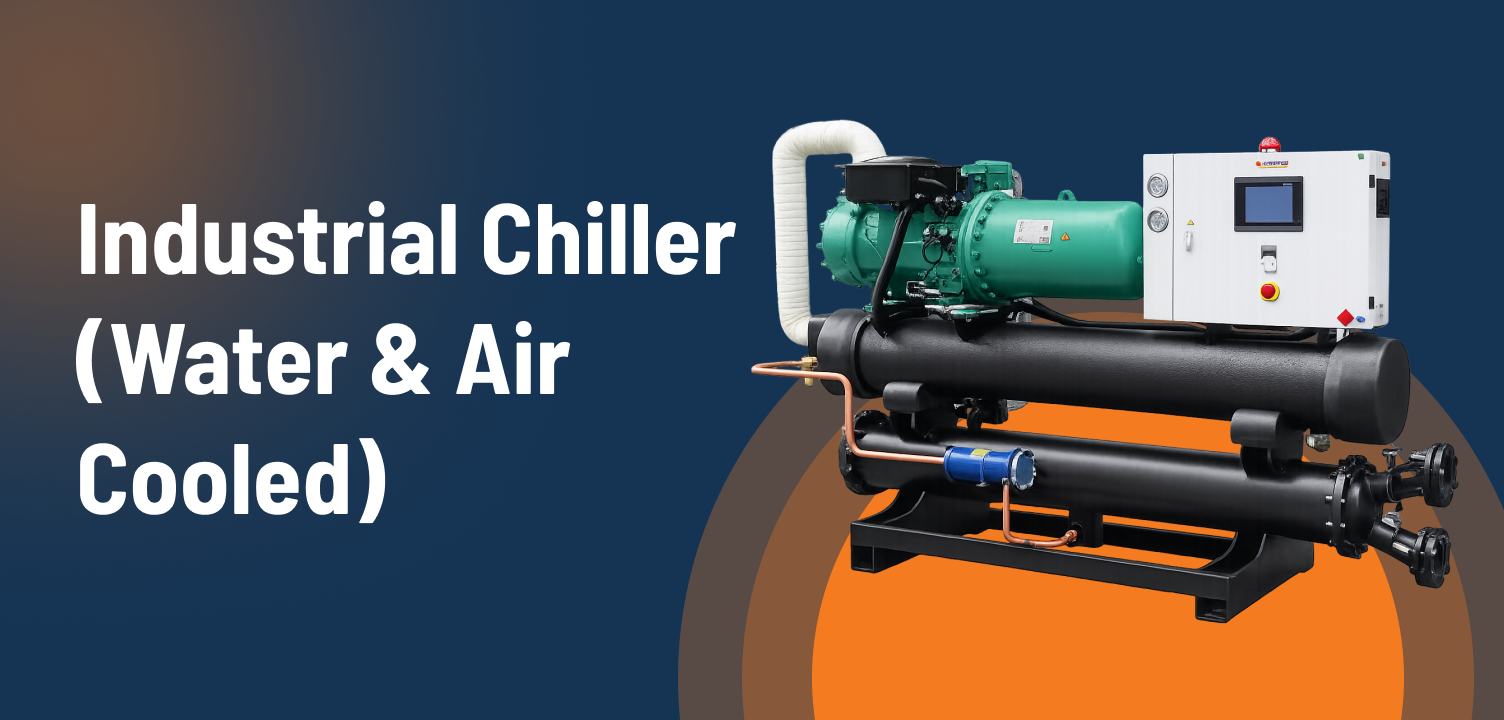
Industrial Chiller is a cooling-only device. It produces chilled water (typically 7-15°C) by running a refrigeration cycle. The chiller’s job is to provide cold water to whatever needs cooling injection moulding machine hydraulics, mould cooling channels (directly, when you don’t need precise control), MTC cooling exchangers, extrusion line cooling baths, and other plant cooling loads. Chillers are sized in tons of refrigeration (TR), typically 2-50+ TR for plastic processing applications.
Mould Temperature Controller can both heat and cool, holding the mould at any target temperature from ambient to its max rating. The MTC takes the chiller’s cold water as a cooling source, then heats it (with electric heaters) or cools it (via heat exchange with chiller water) to deliver the precise temperature your mould needs.
Think of it this way: the chiller is your cold-water utility; the MTC is your point-of-use temperature controller. A typical injection moulding plant uses ONE chiller for the whole plant, plus ONE MTC per machine (or per mould zone).
For complete temperature control infrastructure, most Indian plastic processors invest in both a properly-sized chiller and one MTC per major moulding machine. Seaways Machinery manufactures industrial chillers from 2 TR to 50+ TR for plastic processing applications, with both water-cooled and air-cooled variants serving the cooling-source needs of MTCs and direct mould cooling alike.
Maintenance Essentials
A well-maintained MTC delivers years of trouble-free service. Neglected MTCs become expensive paperweights within 12-18 months. Essential maintenance:
Daily Checks
- Verify fluid level in tank (top up if low)
- Check temperature display matches expected set point and process feel
- Listen for unusual pump noise or vibration
- Visually inspect hoses for leaks or signs of wear
Monthly Maintenance
- Inspect heater elements for scale buildup (water-type) or oxidation (oil-type)
- Check thermocouple accuracy against a calibrated reference
- Verify solenoid valve operation and seating
- Clean cooling water filter on the heat exchanger inlet
- Inspect electrical connections for corrosion or loosening
Quarterly / Semi-Annual
- Drain and flush fluid loop (water-type) to remove scale and contamination
- Test pressure relief valve operation on pressurised systems
- Inspect and lubricate pump bearings
- Replace fluid filters if equipped
Annual
- Full electrical safety inspection
- Test all safety cutoffs (overtemperature, overpressure, low level)
- Inspect or replace thermal oil if equipped (oil degrades over time)
- Verify pump and motor performance against original spec
Mould Temperature Controller Prices in India
Indian MTC pricing varies significantly by manufacturer (Indian-made vs imported), capacity, temperature range and feature level. Typical 2026 price bands:
| MTC Type & Capacity | Indian Manufacturer | Imported (Taiwan/China) | European |
|---|---|---|---|
| Water-type 6 kW | ₹45,000 – ₹70,000 | ₹70,000 – ₹1.2 L | ₹2-3 L |
| Water-type 9-12 kW | ₹70,000 – ₹1.4 L | ₹1.2 – 2 L | ₹3-4 L |
| Water-type 18-24 kW | ₹1.4 – 2.2 L | ₹2 – 3 L | ₹4.5-6 L |
| Pressurised water 120°C | ₹1.5 – 2.5 L | ₹2.5 – 4 L | ₹5-8 L |
| Pressurised water 180°C | ₹2.5 – 3.5 L | ₹3.5 – 5.5 L | ₹7-10 L |
| Oil-type 24-36 kW | ₹2.5 – 4 L | ₹4 – 6 L | ₹8-12 L |
Indian-manufactured MTCs offer significant cost savings over imported equivalents, with quality that has improved substantially over the past decade. For most Indian processors, an established Indian MTC manufacturer offers the best price-to-quality ratio along with local service and shorter lead times.
Wrapping Up
A properly-specified mould temperature controller is one of the highest-leverage investments an injection moulder can make. The right MTC eliminates an entire category of part defects, stabilises cycle times, improves dimensional consistency and ultimately drives both yield and throughput improvements. The wrong MTC undersized, cheap, lacking PID control does the opposite, becoming a hidden source of quality problems and operator frustration.
For Indian plastic processors evaluating MTC investments, the practical steps are: identify your material’s mould temperature target, choose water-type or oil-type accordingly, size heating capacity to your mould and cycle requirements, verify your chiller can provide adequate cooling source, and insist on PID control with proper safety cutoffs. These five decisions get you 90% of the way to a successful MTC purchase.
If you’re setting up a new moulding plant or upgrading your auxiliary equipment, both the MTC and your industrial chiller are critical infrastructure that should be sized together they work as a system. At Seaways Machinery, we manufacture industrial chillers (water-cooled and air-cooled, 2-50+ TR) that pair well with MTCs from any reputable manufacturer; if you’re planning a complete cooling and temperature control setup, our engineering team can help you size both pieces together. Get in touch with your material type, machine size and shift hours; we’ll send a complete recommendation within 24 working hours.